Showing posts with label Gallipoli. Show all posts

Aug 12, 2014

Harold Alfred EUSTACE [1892 - 1915]

 The forgotten Battle of Sari Bair Range ~ August 1915

Located just 40 minutes south of Burnie in Tasmania, Australia, lies the quiet little town of Waratah.

map showing Mt Bischoff and Waratah in Tasmania.

Map of Tasmania, a southern state of Australia.

This was the birthplace of the Tasmanian tin mining industry and introduced Tasmania to an industrial era.

In 1871, while prospectors searched for gold, silver and osmiridium along the Pieman and Donaldson Rivers, James ‘Philosopher’ Smith found tin at Mt. Bischoff.  This was the beginning of the mining era, a mining era that took the state out of financial crisis and saved Tasmania.


It was here at Mt Bischoff that John Eustace was born in the September of 1848. 
  John's parents and family remained living in this area for many years and it was about 1880 that John Eustace married Mary Duncan. Mary and John had seven known children, two of these children being sons - Harold and John - who worked as miners in the local mines.

Harold Alfred Eustace was born in Waratah on 21st November 1892 and his brother - John Montague Eustace - was born on 31st August 1896.


War was declared in the August of 1914 and just a few weeks later, both John and Harold enlisted in the AIF.  John was 18 years of age and Harold was 21 years of age.  Harold's service number being 1031 and John's was 1032.

They were both admitted into the 15th Battalion, G Company and both embarked Melbourne on 22nd December 1914 on board the HMAT A40 CERAMIC bound for the Middle East.


Harold Alfred Eustace - 1914

On Harold's enlistment papers he is described as being 22 years of age, 5'7" tall (170cm) weighed 11 stone (70kg) had a fair complexion, brown hair and brown eyes and his religion was listed as Church of England. He also had a tattoo on his right forearm.

Their training was undertaken at the Broadmeadows Camp.

Prior to heading off to the Middle East, the 15th Battalion marched through the streets of Melbourne on 17th December 1914.


Crowds line Collins Street, Melbourne to watch the parade of signallers, band and men of the 15th Battalion, commanded by Lieutenant Colonel J H Cannan, while the 4th Infantry Brigade, under the command of Colonel J Monash VD, marched to and from Broadmeadows Camp. Note the spectators looking from the building windows and roofs.

On 22nd December, 1914 the battalion was marched to Broadmeadows Station and left by two special trains to Port Melbourne where they boarded the HMAT CERAMIC a White Star liner. They steamed out of Melbourne at 2pm bound for Albany, Western Australia where the ship would join the fleet of transports heading for Europe. Owing to the lack of deck space, the training of the troops at sea was difficult. However, four times a day parades were held with instruction in musketry, physical training and rifle exercises. Many of the men suffered from sea sickness in the Great Australian Bight however most were was well enough to attend Church Parade on Christmas Day, 1914 and enjoy a Christmas meal of cold pork, potatoes, haricot beans and tough plum pudding.


Finally on 20th January, 1915 the Ceramic entered Aden Harbour in what is today, Yemen. The harbour had many ships anchored including the Empress of Russia a liner that had been requisitioned by the British Admiralty and armed for active service. As well there were many native craft and before long they had thrown their lines on board and the natives were trading with the troops much to their amusement and delight. The weather was calm and very hot.

On the 30th January the convoy moved single file into the Suez Canal. Priority was given to the troop convoy and emigrant ships such as Orsova and others had to wait for them to pass.

The troops were anxious to disembark; they had heard of heavy fighting on the Suez Canal, however, bad weather prevented their disembarkation until 3rd February at Alexandria. There was a close call with the Ceramic breaking three lines, and she was she was nearly blown onto the Eastville. The next day they landed and loaded their kit bags onto trucks with some kit bags having disappeared from the hold during the trip. Police had difficulty keeping the Egyptians from the gangway and before disembarking the men had been warned not to drink the water, alcohol or not to seek the comfort of local woman as venereal disease was very prevalent. The battalion travelled to Cairo by train arriving the next day.


The Camp at Heliopolis in Egypt


From 3rd February until 5th April 1915, the 15th battalion camped at Aerodrome Camp, Heliopolis and was trained in battalion, brigade and divisional fighting. Despite the warnings given to the men, many succumbed to the temptations of Cairo and charges of drunkenness and absent without leave were plentiful as well as admissions to hospital for venereal disease.

The 15th Battalion left Alexandria on the transport ships Australind and Seang Bee bound for Lemnos Island. The Seang Bee arrived at Lemnos on the 14th April. The troops were trained in disembarkation of the ship into cutters and horseboats until the 24th April. On the 25th April the Australind  with headquarters staff, B & D Companies reached the entrance to the Dardanelles and witnessed the landing and bombardment of the landing British troops.

The Seang Bee anchored at about 4.00 pm opposite the disembarkation point and, at 4.30 pm a destroyer took off 2 companies, however, they were not landed until 10.30 pm. While waiting the destroyer came under fire from shrapnel and four men were hit.

From May to August the 15th Battalion was heavily involved in establishing and defending the front line of the Anzac Beachhead.

The August Offensive in the Sari Bair Range, 6–10 August 1915

Turkish  artillery in action on Gallipoli, 1915.
Turkish artillery in action on Gallipoli, 1915.
[AWM A05290]

On 6th August, the Allies launched an offensive in an effort to try to break the deadlock, during which the 15th Battalion attacked the Abdel Rahman Bair heights, which was known to the Australians as "Hill 971".


In reading the account of
The August Offensive in the Sari Bair Range, 6–10 August 1915  it certainly brings to the fore
the sheer numbers of loss of life and the overwhelming numbers of the severely wounded.

In one of these valleys Private Ormond Burton, New Zealand Medical Corps, witnessed the plight of some 300 wounded:


No-one appeared to be responsible for them. Their wounds were uncared for and in the heat some were in a shocking state. They had no food and no water .... Many were hit a second and third time as they lay helplessly … Many died there, some able to see the hospital ships with their green bands and red crosses no distance out to sea. On one trip I gave my water bottle to a Turkish officer with four or five of his men about him. He gave every drop to his men and took not a mouthful himself. I saw nothing more dreadful during the whole war than the suffering of those forgotten men.
 

Stretcher-bearers at work during the August offensive in the Sari Bair Range. They are probably members of the 4th Australian Field Ambulance at Walden Grove
From the diary of the 15th Bn on the afternoon of the 7th August 1915

WIA on 7th August 1915 at Gallipoli
admitted and transferred to Mudros
prior to being admitted 'dangerously ill' to Hospital in Alexandria via HS DELTA
.


In the early hours of 8th August, three battalions of the 4th Brigade–the 14th, 15th and 16th–set out. Dawn found them nowhere near the approach to Kocacimentepe. As the Australian battalions advanced over an exposed slope, Turkish machine guns opened up. Against this concentrated Turkish fire little progress was made. In the words of the Australian official history, the 15th Battalion, with most of its officers dead or wounded, ‘broke southwards’ for cover. One Australian who disappeared on 8 August as the 15th came under attack was Sergeant Joseph McKinley of Yass, New South Wales. A comrade wrote:


The men fell under furious fire. It was terrible; the men were falling like rabbits. Many were calling for mothers and sisters. They fell a good way, in many cases, from the Turkish lines. Sgt McKinley … did very good work on the Peninsula. It was commonly believed that he was killed on that morning during the advance. He was never seen again.

Harold Eustace was admitted to the 17th General Hospital is Alexandria on 11th August 1915 and the notes in his service records state "seriously wounded with a gun shot wound to the pelvis, buttock and right thigh". He later developed pneumonia and died on 7th September 1915. One month after he was wounded in the Battle of Sari Bair Range at Gallipoli.

He is buried at in Plot H grave 19.
Chatby War Memorial Cemetery at Alexandria, Egypt.


Below is a letter from his father - John Eustace of Zeehan, Tasmania - to The Minister for Defence in Melbourne requesting the date in which Harold was killed.


DIED OF WOUNDS.

Mr. J. Eustace of Rosebery has received word from the Secretary for Defence that his son Private Harold Eustace succumbed to his wounds at the 17th General Hospital, Alexandria. The deceased went with the Second Expeditionary Force, and resided at Burnie a few years ago. He was 23 years of age. His brother, John Eustace, who has been twice wounded, is at present an inmate of the 1st Australian General Hospital, Heliopolis.

The North Western Advocate 30th September 1915


LEST WE FORGET

Harold Alfred Eustace
1892 - 1915


his brother - John Montague Eustace - returned to Australia after being wounded. His story will appear at a later date.


with grateful thanks to the following websites for help & support
but especially for the use of their data and images so that we can have access to 

The Anzac Landing


some of the above detail in the blog post 

regarding the actual voyage 
of HMAT Ceramic in 1914
came from the diary of

Herbert William Cooke


who was also in the 15th Battalion and
was born in Dundatha in 1893 in Queensland


Harold Alfred EUSTACE is not directly related to myself, he is related to my two children thru their paternal line.

.


.

Aug 8, 2014

James Andrew RALPH [1897 - 1915]


James Ernest Ralph is the second child of Alfred Ernest Ralph and Mary Annie Brennan who were married at Fitzroy, Victoria, Australia on 29th April 1893.

James (or Jim as he was known) was born in Carlton,  a suburb of Melbourne on 7th January 1897 and it was probably around 1909 before the family moved to Coolamon in New South Wales.

 
Jim left his family home at Coolamon, NSW, and unbeknown to his family, enlisted at Liverpool (Sydney) on 19 Jan 1915, and was given the service Number 2013.  His enlistment papers, first copy, are in his own handwriting, and allow the reader to appreciate the human side of his character when compared to subsequent sanitised copies of the form.   Jim gave his age as 21, yet he was born in 1897, making him 17 on enlistment.   He was aware that he needed his parents permission to join, and knowing that wouldn't be given, he cheated and upped his age.  

By the time his parents became aware he had enlisted, it was too late, he had left Australia.  On 13 Apr 1915 he boarded HMAT A55 "Kyarra" enroute from Sydney via Perth to Gallipoli.  


His enlistment form also shows his immaturity and lack of education.   He spelt his birth place Melbourne without the "e".   He left the "r" out of Andrew.   He nominated his "Farther" as his next of kin.   He claimed his occupation as a "Farm Woker", on another form "Farm Wroke".  

None of this should detract from his love of freedom for his nation, his desire to serve his country, and his love of his family.


Jim was 5' 8" tall (170cm) with a chest measurement of 31", expanding to 33 1/2".  He weighed 134lbs, (about 58kg).  His complexion was fair, eyes were blue and his hair was fair.   His religion was RC.  Various subsequent enlistment documents show a variety of "distinctive marks".    Varying from one form to the next he had a vaccination scar (location not stated), on another he had a "scar on right side forehead".   Another states he had only a "scar on left forearm".

While Jim was 'at sea' on board the Kyarra,
his Battalion - The 4th Battalion - took part in the Anzac landing on 25 April 1915 as part of the second and third waves.

This blog posting is perhaps more about the 4th Battalion and the Battle of Lone Pine than of James Ralph himself. It is because we know so little about him personally and quite a bit more is available regarding the 4th Battalion and the Battle of Lone Pine!


The 4th Battalion was among the first infantry units raised for the AIF during the First World War. Like the 1st, 2nd and 3rd Battalions it was recruited from New South Wales and, together with these other battalions, formed the 1st Brigade.
The battalion was raised within a fortnight of the declaration of war in August 1914 and embarked just two months later. After a brief stop in Albany, Western Australia, the battalion proceeded to Egypt, arriving on 2 December. The battalion took part in the Anzac landing on 25 April 1915 as part of the second and third waves. The commander of the 4th Battalion, Lieutenant Colonel A. J. O. Thompson, was killed the next day.

At Anzac, the battalion took part in the defence of the beachhead and in August 1915, along with the rest of the 1st Brigade, led the charge at Lone Pine. This is when Pvt James Andrew Ralph was killed.

The battalion served at Anzac until the evacuation in December.


On 17th June 1915, James joined his Battalion at Gallipoli and the following day (18th) he was at McLaurin's Hill where they were doing Trench Garrison Duty.  There was heavy fighting during this time, but they continued with "trench duty" until early August.

On 1st August 1915 the 4th Bn was relieved by the 8th Battalion and withdrew 'for some rest'. 

McLaurin's Hill is named after Colonel H. N. McLaurin who was KIA 27 April 1915 and is buried here McLaurin's Hill.


The "Ottoman Empire" was the original name for Turkey

When going through the diaries of the 4th Battalion, I came across one of the 'messages'.  These 'messages' were delivered by 'runners' usually.  Their duties were quite straightforward - to carry messages to and from the officers, from a Commander stuck in a trench to his battalion CO; from the Battalion to Battalions, and so on.

Clearly identifiable - at least in daylight - by the red arm-bands fixed around their left forearm, trench runners (or messengers) were drawn from both a specialised and everyday background.  The function of a runner was not simply to bear messages from one area or command unit to another, although this featured prominently.

More critically - and requiring specialisation - qualified runners would be expected to closely familiarise themselves with areas of the front line into which a battalion would soon enter, generally so as to relieve the line's present occupants. In order therefore to be able to guide the newly-arriving troops with accuracy - particularly given that many such troop movements were undertaken nocturnally under cover of darkness - runners would need to excel both at map-reading and at reconnaissance, generally working in pairs and often with perhaps eight working upon the same task at various parts of the line.

Speed and accuracy were essential in ensuring that the relieving force were in place before daylight; in short, before the enemy force could catch troops in the open with artillery fire.

The following is one of those message's written on 20th July 1915 from the First Infantry Brigade and it reads as:

Propose to occupy crater opposite 4th Bn. tonight (?) please instruct your night unit and Japanese Mortar not to fire in this direction.

 
One has to wonder how accurate these messages were, or at the very least how often were they believed or taken notice of?


In the afternoon of Friday 6th August 1915, The Battalion was formed at 3.15pm preparatory to moving to attack in Lone Pine. An attack was launched at 5.30pm.

The Battalion suffered severe casualties and returned to Anzac Cove on 9th Aug.


The Battle of Lone Pine (also known as the Battle of Kanlı Sırt) was fought between Australian and Ottoman Empire (now known as Turkey) forces during the First World War between 6 and 10 August 1915. Part of the Gallipoli campaign, the battle was part of a diversionary attack to draw Ottoman attention away from the main assaults against Sari Bair, Chunuk Bair and Hill 971, which became known as the August Offensive.

The Australians, initially at brigade strength, managed to capture the main Ottoman trench line from the battalion that was defending the position in the first few hours of the fighting; however, the fighting continued for the next three days as the Ottomans brought up reinforcements and launched numerous counterattacks in an attempt to recapture the ground they had lost. As the counterattacks intensified the Australians brought up two fresh battalions.

Finally, on 9 August the Ottomans called off any further attempts and by 10 August offensive action ceased, leaving the Australians in control of the position. Nevertheless, despite the Australian victory, the wider August Offensive of which the attack had been a part failed and a situation of stalemate developed around Lone Pine which lasted until the end of the campaign in December 1915 when the Australian troops were evacuated from the peninsula.


above image .....

A trench at Lone Pine on 8 August 1915. The scene captures something of the savagery of the action. Sergeant Apear de Vine, 4th Battalion, NSW, of Maroubra, Sydney, wrote of the dead:

they are stacked out of the way in any convenient place sometimes thrown up on to the parados so as not to block the trenches, there are more dead than living

[De Vine, quoted in Bill Gammage, The Broken Years, Ringwood, 1990, p 84] [AWM A04029]


Lone Pine was a strong and important position to the Turks. They had not expected such an attack here and the order was quickly given to retake lost positions. For three days and nights Australians and Turks struggled in the trenches and dark tunnels of Lone Pine until the area was choked with the wounded, dying and dead:

The wounded bodies of both Turks and our own … were piled up 3 and 4 deep … the bombs simply poured in but as fast as our men went down another would take his place. Besides our own wounded the Turks’ wounded lying in our trench were cut to pieces with their own bombs. We had no time to think of our wounded … their pleas for mercy were not heeded … Some poor fellows lay for 30 hours waiting for help and many died still waiting.


[Private John Gammage, 1st Battalion, quoted in Les Carlyon, Gallipoli, Sydney, 2001, p 360]

Lone Pine was a battle of bombs, bullets and bayonets fought to defend sandbag walls built by both sides to block up a trench at the forward most point of the advance or counter attack. The Australians tried to hold what they had taken; the Turks fought equally determinedly to expel them from it.

James Andrew Ralph was KIA sometime between 6th and 9th of August 1915 at Lone Pine, though it is believed to have been 6th August when most of the fierce battle took place.


Some readers may be aware of the 4th Battalion Parade Ground Cemetery near Anzac Cove.

The 4th Battalion Australian Imperial Force (AIF) was drawn from New South Wales. From the end of April to the beginning of June 1915, it buried its dead, and six from other units, in a cemetery on the road from Wire Gully to Anzac Cove (Bridges Road). This burial ground became known as the 4th Battalion Parade Ground Cemetery; and it was enlarged after the Armistice by the concentration of 76 graves from two smaller cemeteries and from the surrounding battlefields. The cemetery now contains the graves of 107 soldiers from Australia, three sailors or Marines from the United Kingdom, and six men whose unit in our forces is not known. Seven of the graves are unidentified by name. The area is 636 square yards.

Further information on the above Cemetery is here.


Pvt James Andrew Ralph - aged 18 years - was one of the 4,934 Australian and New Zealand troops killed in the sector that were never identified and have no known grave.

In addition special memorials commemorate 182 Australian and 1 British soldier thought to be buried in the cemetery but whose graves have not been identified.


This year’s artwork by noted Australian artist Drew Harrison was commissioned especially for the 2013 Sands of Gallipoli Collection. It depicts the initial Lone Pine assault late in the afternoon of August 6 as three Australian battalions of the 1st Brigade storm open ground to challenge the main Turkish front trenches. Despite superb fortification by the Turks the Australian battalions took just 20 minutes to win the ground. Over the next three days a bloody battle ensued as Turkish soldiers relentlessly fought to regain the lost territory.


James Andrew Ralph
was one of the above brave men 
that stormed the Turkish trenches
but lost his life in doing so.

may he rest in peace


The short and tragic Army service of James Andrew Ralph was rewarded by the posthumous awards of :

     *   1914-15 Star. (13Aug1920)

     *   British War Medal 1914-20. (15Jul1921)

     *   Victory Medal (1922).


     *   Memorial Scroll and King's message, (15Aug1921)

     *   Memorial Plaque.

      *   Anzac Commemorative Medallion 1965.


AIF Postcard: This "Au Revoir" AIF postcard was not signed by James Andrew Ralph. It is assumed that James intended to send the card to his family, but his death at Lone Pine intervened. It was lovingly kept with his service medals and his War Graves of the British Empire Cemetery Register amongst the private possessions of his sister, Myrtle. Prior to her death in 1977, she passed these only mementos of her favourite brother to her son Robert John Matthews upon his return from active service in South Vietnam.


James Andrew Ralph's 
name will be projected onto the exterior of the
Hall of Memory at AWM in Canberra on:

Wed 20 August, 2014 at 9:03 pm
Sat 4 October, 2014 at 4:37 am
Thu 27 November, 2014 at 12:16 am
Wed 21 January, 2015 at 2:20 am
Sat 14 March, 2015 at 12:50 am
Tue 28 April, 2015 at 12:43 am
Mon 8 June, 2015 at 1:34 am
Wed 15 July, 2015 at 6:31 pm

These dates and times are estimates.
The actual time of projection could change as a result of weather and other factors, so it is advisable to check closer to the date. In the rare  event of a temporary loss of electrical power, the names scheduled for display in that period will not appear until the next time listed.


1914-15 Star, may be awarded to those who saw service in a prescribed Theatre of War between 5 August 1914 and 31 December 1915, commonly referred to as "Pip". (2) British War Medal, for service during and immediately after WW 1, known as "Squeak". (3) Victory Medal, awarded to all members of the 14 Allied Powers who entered a theatre of war on duty in WW 1, known as "Wilfred".
Nicknames came from comic strip characters published in the Daily Mirror.


From Robert Matthews....

James sister, Myrtle Ralph, aged 8 at the time of his death, had a lifelong belief that Jim was buried at Lone Pine Cemetery in Grave Site 23.   In April 2008 it was established that Jim's body was never identified, he has no known grave, but is presumed buried with his other 4900 "unknown" comrades and foe, at Lone Pine, known only unto their God.  
His death is commemorated on Panel 23 at the Lone Pine Memorial, Gallipoli.

In Feb 2010, the son of Myrtle - Robert Matthews - was researching stories of other "Unknown" soldiers killed in WWI.  

He came across a poem, written by Michael Edwards called "The Visitor".   The poem illustrates the distressed feelings of the lost soul of a lonely Unknown Soldier, lost for almost one hundred years, and underlies the relief when family eventually came to the cemetery and reclaimed, not his unknown lost body, but his lost soul.


"I half awake to a strange new calm
And a sleep that would not clear
For this was the sleep to cure all harm
And which freezes all from fear.

Shot had come from left and right
with shrapnel, shell and flame
And turned my sunlit days to night
Where now none would call my name.

Years passed me by as I waited,
Missed the generations yet to come,
Sadly knew I would not be fated
To be a father, hold a son.

I heard again the sounds of war
When twenty years of sleep had gone,
For five long years, maybe more,
Til peace once more at last had come.

More years passed, new voices came,
The stones and trenches to explore,
But no-one ever called my name
So I wished and waited ever more.

Each time I thought , perhaps, perhaps,
Perhaps this time they must call me,
But they only called for other chaps,
No-one ever called to set me free.

Through years of lonely vigil kept,
To look for me they never came,
No-one ever searched or even wept,
Nobody stayed to speak my name.

Until that summer day I heard
Some voices soft and stained with tears,
Then I knew that they had come
To roll away those wasted years.

Their hearts felt out to hold me,
Made me whole like other men,
But they had come just me to see,
Drawing me back home with them.

Now I at peace and free to roam
Where 'ere my family speak my name,
That day my soul was called back home
For on that day my family came."


with grateful thanks to the following websites for help & support
but especially for the use of their data and images so that we can have access to what is needed for us to remember our fallen hero's:


AWM 4th Battalion War Diaries

Australian War Memorial

Australian National Archives


Wikipedia - Battle of Lone Pine

Commonwealth War Graves Commission

Sands of Gallipoli


and many thanks to Rob Matthews (nephew of James Ralph)

for the help, support and of course, the extra data!

LEST WE FORGET


.


Jul 22, 2014

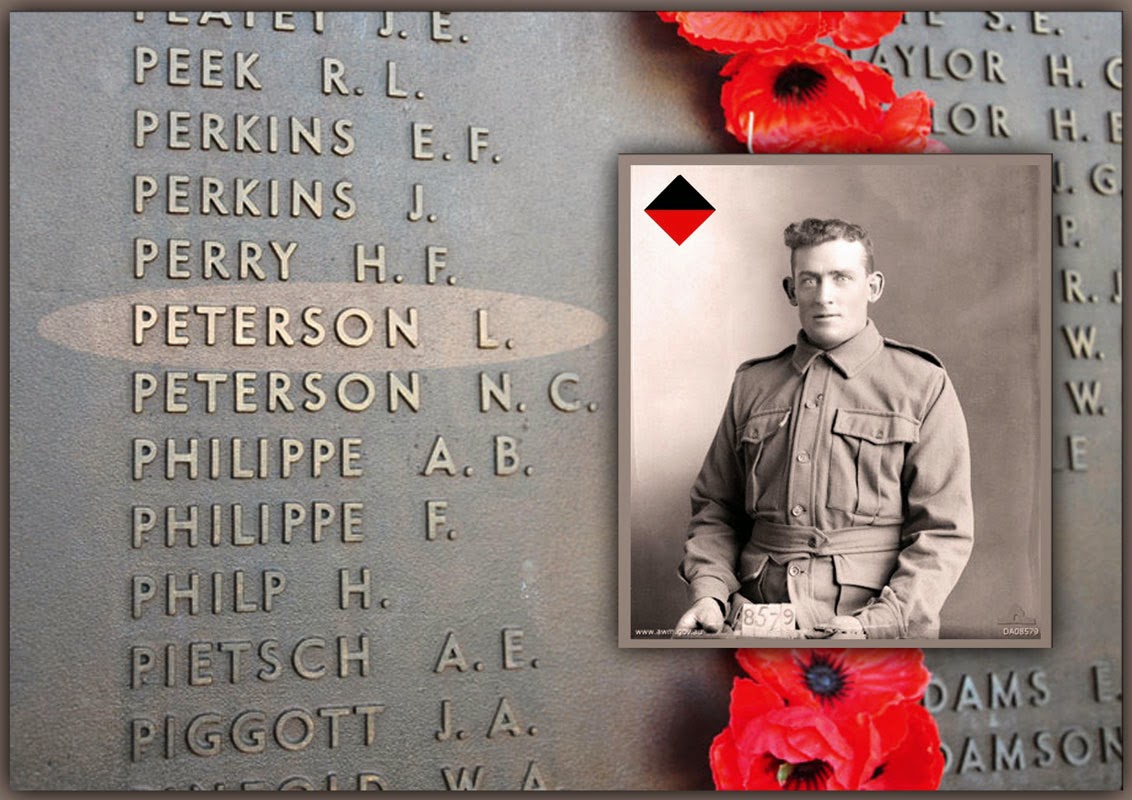
Leonard Peterson - KIA 25th November 1915


Ok young Lennie, tell me why you did it?

Lennie Peterson joined the AIF in January 1915 and promptly changed his name to Peter Palmer.

Why?

He was born in Cheltenham, he was 25 years of age and his parents were Swedish, so cannot see why he would have any reason to change his name. 

But he did.

Lets go back aways, back to his parents so you have some background on young Lennie.

Frederick Adolph Peterson was born in February 1854 in a small village called Turinge, in Sodermanland, Sweden, SW of Stockholm as seen in the image below.


In October 1875 he sailed into Melbourne on board the 44 ton schooner the "Black Hawk" after departing New York some two months earlier.


By the time he was 31 years old, he had met and married 20 year old Emma Butler.  Adolph and Emma went on to have eleven children, with six of them dying before they had reached the age of 10.

One of the eleven children was named Leonard Peterson.

Leonard was born in November 1889 at home in Cheltenham. By the time he was 24 years old, The Great War had commenced and it did not take him long to "sign up" for the AIF.

Lennie enlisted in Melbourne on 29th January 1915 under the name of PETER PALMER with a service number of 722. He was allocated to the 21st Battalion / 6th Brigade. He listed his mother - Mrs E. Peterson - as his 'next of kin'.


a selection of the AIF papers belonging to Peter Palmer.

The 21st Battalion was raised, as part of the 6th Brigade, at Broadmeadows in Victoria in February 1915. Its recruits hailed from all over the state. The later enlistment of these men, and their average age of 29, would seem to indicate a more considered decision to enlist that set them apart from those who did so amidst the heady enthusiasm of late 1914.

Lennie, or Peter as he was known, did his training at Broadmeadows camp for the next three months and on 8th May 1915
the Battalion left Broadmeadows camp  at 11am and proceeded by train to Melbourne. The Battalion boarded the HMAT Ulysses (15,000 tons) at 4.30pm and sailed at 8pm on the same day.

Embarkation was quietly carried out. There was no fanfare of trumpets, and that night they slipped from the pier down the bay in company with the "Euripides" which carried the 23rd and 24th Battalions.

image above right is of the HMAT Ulysses in port at Port Melbourne, left image is 'at sea'.

"On arrival at Alexandria, at 2 pm on 8th June, most of the troops took French leave for the evening. Next day we entrained for Helmieh Siding, thence we marched to the Aerodrome Camp, Heliopolis, which was our home for the next three months".


From 12th to 23rd August "C" Company garrisoned the Cairo Citadel, the other three companies, Kasr-el-Nil and Bab-el-Hadid Barracks in the city it self. They were the first Australian troops to act as garrison in Cairo.

By the 29th August they had
returned to Heliopis & absorbed the 1st & 2nd reinforcements, which brought them to full strength, on 29th Aug entrained at Helmieh Siding, fully trained Aust.unit ready to take their place beside the 1st Div. which had already made its name on Gallipoli.

The following day - 30th August - they embarked at Alexandria on board the "Southland", but two days later they were very much taken by surprise when the transport was torpedoed off the Island of Stratae, near Mudros Bay at 9.50am.

above image:
on right is the transport ship 'SOUTHLAND' which was torpedoed while
conveying Australian & New Zealand Troops to Gallipoli.
on left is the 21st Bn after the torpedo attack.


The "Southland" then, under her own power was beached in Mudrus Harbour about 7 pm. All the small boats were picked up by 3.30 pm and the Battalion was reorganised and refitted on board the "Transylvania" at Mudros. We transshipped to the transport "Abassieh" on the evening of 6th September and were landed at ANZAC Cove before midnight. Next day we took over the line which was to be our home for three and a half months.


various images of ANZAC COVE in 1915

Between 24 & 27 November, the troops at Anzac Cove were ordered not to fire on the Turks unless they were attacked or threatened. This so-called ‘Silent Stunt’ was to help deceive the enemy into thinking that a silence did not necessarily mean withdrawal.

On 25th November 1915, Leonard Peterson was killed in action at Gallipoli and is buried at Shrapnel Valley Cemetery. Just 10 months after he enlisted in the Australian Army.


image above shows Shrapnel Valley Cemetery
and the location of where Leonard Peterson is buried.


Leonard Peterson's name is located at panel 94 in the
Commemorative Area of the Australian War Memorial
in Canberra, ACT, Australia.
above image shows some of the paperwork between the Australian Defence Department
and the family of Leonard Peterson, in particular his sister
Winifred Violet Stanley (nee Peterson)
memorial notice in the Melbourne Argus newspaper.


May he and his comrades forever 
rest in peace in the valley at Anzac Cove.


LEST WE FORGET
with grateful thanks to the Australian War Memorial and the Australian National Archives for the information they provide on their websites and for which I have used most images and data in the above blog post.


as a side note, it was in April 1918,
Leonard Peterson's father - Adolph Peterson - became a naturalized Australian.


other posts on family members that enlisted in the AIF


  • Roll of Honour name projection - July 2014

    Leonard Peterson's name will be projected onto the exterior of the Hall of Memory at the AWM in Canberra on:

  • Sun 14 September, 2014 at 4:00 am
  • Mon 3 November, 2014 at 3:01 am
  • Sat 27 December, 2014 at 9:05 pm
  • Thu 19 February, 2015 at 5:29 am
  • Thu 9 April, 2015 at 6:11 am
  • Thu 21 May, 2015 at 3:56 am
  • Sun 28 June, 2015 at 11:32 pm
  • Thu 6 August, 2015 at 3:39 am

These dates and times are estimates. The actual time of projection could change as a result of weather and other factors, so it is advisable to check closer to the date. In the rare event of a temporary loss of electrical power, the names scheduled for display in that period will not appear until the next time listed.