
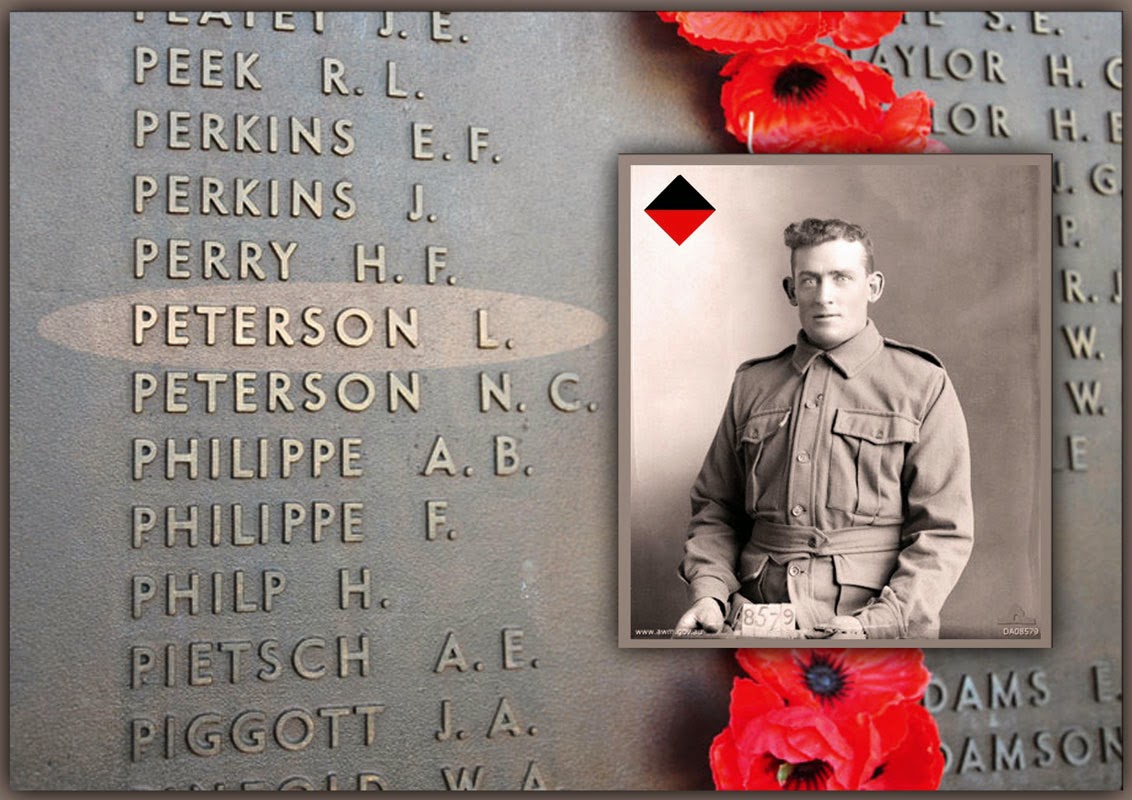
Ok young Lennie, tell me why you did it?
Lennie Peterson joined the AIF in January 1915 and promptly changed his name to Peter Palmer.
Why?
He was born in Cheltenham, he was 25 years of age and his parents were Swedish, so cannot see why he would have any reason to change his name.
But he did.
Lets go back aways, back to his parents so you have some background on young Lennie.
Frederick Adolph Peterson was born in February 1854 in a small village called Turinge, in Sodermanland, Sweden, SW of Stockholm as seen in the image below.

In October 1875 he sailed into Melbourne on board the 44 ton schooner the "Black Hawk" after departing New York some two months earlier.
One of the eleven children was named Leonard Peterson.
Leonard was born in November 1889 at home in Cheltenham. By the time he was 24 years old, The Great War had commenced and it did not take him long to "sign up" for the AIF.
Lennie enlisted in Melbourne on 29th January 1915 under the name of PETER PALMER with a service number of 722. He was allocated to the 21st Battalion / 6th Brigade. He listed his mother - Mrs E. Peterson - as his 'next of kin'.
 |
| a selection of the AIF papers belonging to Peter Palmer. |
The 21st Battalion was raised, as part of the 6th Brigade, at
Broadmeadows in Victoria in February 1915. Its recruits hailed from all
over the state. The later enlistment of these men, and their average age
of 29, would seem to indicate a more considered decision to enlist that
set them apart from those who did so amidst the heady enthusiasm of
late 1914.
Lennie, or Peter as he was known, did his training at Broadmeadows camp for the next three months and on 8th May 1915 the Battalion left Broadmeadows camp at 11am and proceeded by train to Melbourne. The Battalion boarded the HMAT Ulysses (15,000 tons) at 4.30pm and sailed at 8pm on the same day.
Embarkation was quietly carried out. There was no fanfare of trumpets, and that night they slipped from the pier down the bay in company with the "Euripides" which carried the 23rd and 24th Battalions.
Lennie, or Peter as he was known, did his training at Broadmeadows camp for the next three months and on 8th May 1915 the Battalion left Broadmeadows camp at 11am and proceeded by train to Melbourne. The Battalion boarded the HMAT Ulysses (15,000 tons) at 4.30pm and sailed at 8pm on the same day.
Embarkation was quietly carried out. There was no fanfare of trumpets, and that night they slipped from the pier down the bay in company with the "Euripides" which carried the 23rd and 24th Battalions.
 |
| image above right is of the HMAT Ulysses in port at Port Melbourne, left image is 'at sea'. |
"On arrival at Alexandria, at 2 pm on 8th June, most of the troops took French leave for the evening. Next day we entrained for Helmieh Siding, thence we marched to the Aerodrome Camp, Heliopolis, which was our home for the next three months".
From 12th to 23rd August "C" Company garrisoned the Cairo Citadel, the other three companies, Kasr-el-Nil and Bab-el-Hadid Barracks in the city it self. They were the first Australian troops to act as garrison in Cairo.
By the 29th August they had returned to Heliopis & absorbed the 1st & 2nd reinforcements, which brought them to full strength, on 29th Aug entrained at Helmieh Siding, fully trained Aust.unit ready to take their place beside the 1st Div. which had already made its name on Gallipoli.
The following day - 30th August - they embarked at Alexandria on board the "Southland", but two days later they were very much taken by surprise when the transport was torpedoed off the Island of Stratae, near Mudros Bay at 9.50am.
 | |
| above image: on right is the transport ship 'SOUTHLAND' which was torpedoed while conveying Australian & New Zealand Troops to Gallipoli. on left is the 21st Bn after the torpedo attack. |
The "Southland" then, under her own power was beached in Mudrus Harbour about 7 pm. All the small boats were picked up by 3.30 pm and the Battalion was reorganised and refitted on board the "Transylvania" at Mudros. We transshipped to the transport "Abassieh" on the evening of 6th September and were landed at ANZAC Cove before midnight. Next day we took over the line which was to be our home for three and a half months.
 |
| various images of ANZAC COVE in 1915 |
Between 24 & 27 November, the troops at Anzac Cove were ordered not to fire on
the Turks unless they were attacked or threatened. This so-called
‘Silent Stunt’ was to help deceive the enemy into thinking that a
silence did not necessarily mean withdrawal.
On 25th November 1915, Leonard Peterson was killed in action at Gallipoli and is buried at Shrapnel Valley Cemetery. Just 10 months after he enlisted in the Australian Army.
On 25th November 1915, Leonard Peterson was killed in action at Gallipoli and is buried at Shrapnel Valley Cemetery. Just 10 months after he enlisted in the Australian Army.
 |
| image above shows Shrapnel Valley Cemetery and the location of where Leonard Peterson is buried. Leonard Peterson's name is located at panel 94 in the Commemorative Area of the Australian War Memorial in Canberra, ACT, Australia. |
 | |
| above image shows some of the paperwork between the Australian Defence Department and the family of Leonard Peterson, in particular his sister Winifred Violet Stanley (nee Peterson) |
 |
| memorial notice in the Melbourne Argus newspaper. |
May he and his comrades forever
rest in peace in the valley at Anzac Cove.
LEST WE FORGET
with grateful thanks to the Australian War Memorial and the Australian National Archives for the information they provide on their websites and for which I have used most images and data in the above blog post.
with grateful thanks to the Australian War Memorial and the Australian National Archives for the information they provide on their websites and for which I have used most images and data in the above blog post.
 |
| as a side note, it was in April 1918, Leonard Peterson's father - Adolph Peterson - became a naturalized Australian. |
other posts on family members that enlisted in the AIF
Arthur Joseph WEIR
Arthur Geraldton HIGGS
Ernest Cockbill KENDRICK
Nelson Wesley Eustace BARWISE
John Russell PATTERSON
Edward Harold ARTSO
Raymond Everard BARTRAM
Arnold Roy BARTRAM
Reginald Percy BARTRAM
James Herbert CLEGG
Carl Walter DALITZ
Heinrich Charles DALITZ
Friedrich Wilhelm DALITZ
Alwin Clarence DALITZ
Gabriel William John DELANEY
Leslie Norman KRAUSE
Charles Richard Le BRUN
William Murdoch Le BRUN
Ernest Lister ROBERTS (1)
Ernest Lister ROBERTS (2)
Ernest Lister ROBERTS (3)
William Gordon TUCKER
Arnold Henry RALPH
Roll of Honour name projection - July 2014
Leonard Peterson's name will be projected onto the exterior of the Hall of Memory at the AWM in Canberra on:
- Sun 14 September, 2014 at 4:00 am
- Mon 3 November, 2014 at 3:01 am
- Sat 27 December, 2014 at 9:05 pm
- Thu 19 February, 2015 at 5:29 am
- Thu 9 April, 2015 at 6:11 am
- Thu 21 May, 2015 at 3:56 am
- Sun 28 June, 2015 at 11:32 pm
- Thu 6 August, 2015 at 3:39 am
These dates and times are estimates. The
actual time of projection could change as a result of weather and other
factors, so it is advisable to check closer to the date. In the rare
event of a temporary loss of electrical power, the names scheduled for
display in that period will not appear until the next time listed.


