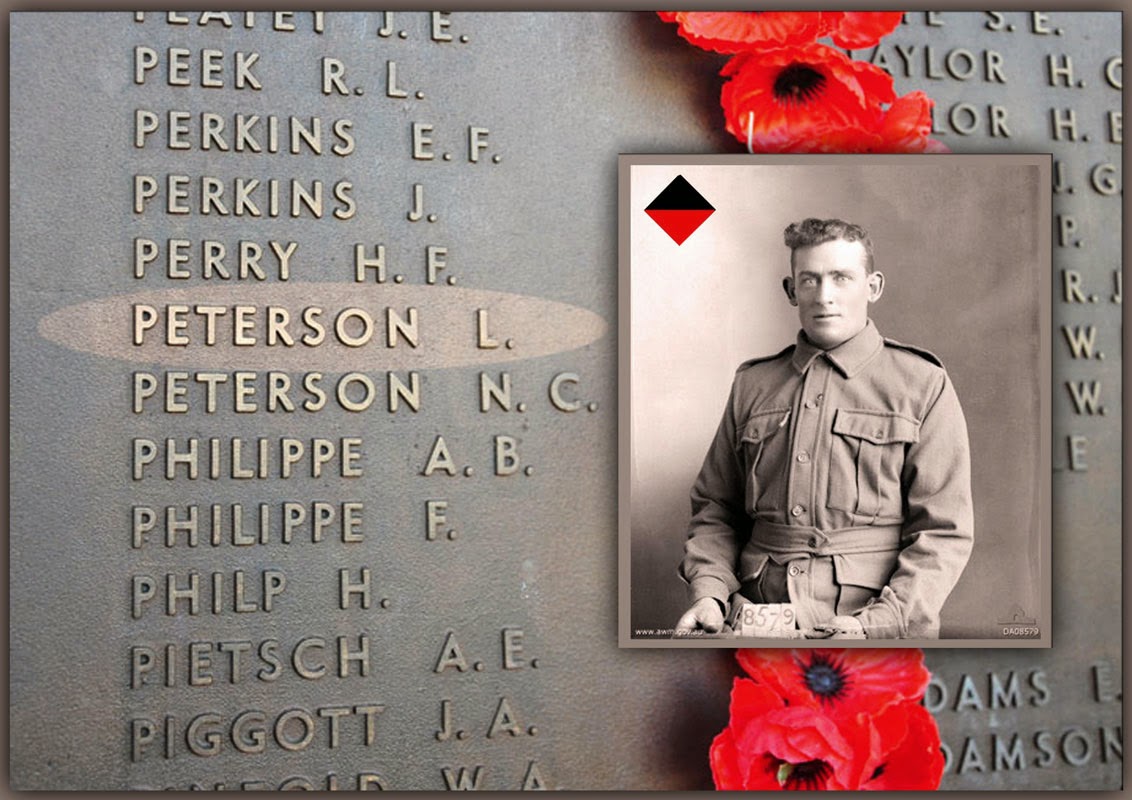
.
Arnold Roy BARTRAM
was born in Richmond,
Victoria, Australia
in 1895 to
George Andrew BARTRAM and Isabella SHANDS
.
George Andrew BARTRAM and Isabella SHANDS
.

George and Isabella were married on 27 August 1878 in Richmond, Victoria, Australia and had seven children.
As a young boy, Arnold attended the Yarra Park State School in East Melbourne.
As a young boy, Arnold attended the Yarra Park State School in East Melbourne.
 |
| Yarra Park State School. Date(s) of creation: [ca. 1900] State Library of Victoria |
He
was a 21 year old Shipping Clerk and living with his parents at 9 Hull
St, Richmond when he enlisted in the AIF on 6 June 1916. Private Bartram at that time was assigned to the 58th Battalion.
Both Arnold and his brother Cyril, were in the 58th Battalion, 4th Reinforcement.
Both Arnold and his brother Cyril, were in the 58th Battalion, 4th Reinforcement.

He embarked from Melbourne for Plymouth per the H.M.A.T. "Orsova," on the 1st of August 1916 with the 4th reinforcements and then proceeded to France per the "Princess Henrietta," on the 6th of December 1916.
 |
| H. M. A. T. "Orsova," |
O5 January 1917 Arnold was "taken on strength" to the 60th Battalion in the field at Fribourt, France.
According to the unit diary - on the 14th January they left Ribmount at 8:30am and marched through Buire to Fricourt Camp where they could shower and enjoy a hot meal ... after all, it was not the best of days to be out 'walking'. The day was quite cold and snow had been falling for at least three hours.
According to the unit diary - on the 14th January they left Ribmount at 8:30am and marched through Buire to Fricourt Camp where they could shower and enjoy a hot meal ... after all, it was not the best of days to be out 'walking'. The day was quite cold and snow had been falling for at least three hours.
 |
| winter of 1917 (thanks to the AWM) |
By the 24th January the 60th Bn was at Needle Trench (near Lesboeufs) in France. The morning seemed to be 'quiet' but by the afternoon Needle Trench was being heavily shelled. The 60th Battalion asked for retaliation which was successful in stopping the enemy's shelling.
The 60th Battalion were around Longueval for the first couple of weeks of February, when they then moved on to the Flers area. Longueval is near where the Battle of Delville Wood took place in late 1916.
Enemy artillery was active throughout the cold and frosty night of 4th March, where they were still in the Flers area. Arnold was admitted to hospital for gastroenteritis on the 13th of March, but back with his Battalion the following week. By the 18th the 60th Bn had evacuated and moved onto Fremicourt where they stayed until 25th March.
During the month of April, the Battalion moved from Beaulencourt, St Aubin, then back to Beaulencourt and onto Mametz where they arrived at 5:00pm on 20th April. The complete Battalion was engaged in camp cleaning & cleansing of persons and stayed at Mametz for the duration of April.
During the month of April, the Battalion moved from Beaulencourt, St Aubin, then back to Beaulencourt and onto Mametz where they arrived at 5:00pm on 20th April. The complete Battalion was engaged in camp cleaning & cleansing of persons and stayed at Mametz for the duration of April.
 |
| the above map will guide you as to the 60th Battalion movements during the first half of 1917 which also shows the movement of Arnold Bartram during this time, where he was KIA and where buried. A - Lesboeufs - January 1917 B - Mametz - April 1917 C - Fricourt - January 1917 D - Longueval - January 1917 E - Haplincourt - March 1917 F - Beulencourt - April 1917 G - Noreuil - May 1917 - KIA at the second Battle of Bullecourt. H - Grevillers Cemetery - where buried. |
With the month of May came the first touch of Spring. The unit diary even makes note of the weather:
02 May 1917 - Fine clear spring day......
03 May 1917 - weather fine, though rather overcast with strong NE winds......
04 May 1917 - fine, warm & clear day with little wind......
05 May 1917 - fine, warm and overcast. ...
06 May 1917 - fine, warm & windy.
On the 10th May the 60th Battalion were at Noreuil and at 10:00am the diary notes that the men were improving their dugouts & clearing up the area they were occupying.
By 9:00pm D Company - who were located in a sunken road on the opposite side of the village were subjected to some heavy shelling. One killed and four wounded... and the following day the forward area was still under constant shell fire.


This is when Arnold received a gun shot wound to the abdomen - in the Second Battle of Bullecourt - on the 12th of May 1917.

He died of his wounds on the 13th of May 1917 aged 21 years.

He was first buried in the soldiers grave between Noreuil & Vaulx. Later buried at Greveillers British Cemetery (actual date NK)


Inscription:
Australian Infantry, A.I.F.
Grevillers British Cemetery
Grevillers
Nord-Pas-de-Calais Region, France
Plot: II. E. 2.
Australian Infantry, A.I.F.
Grevillers British Cemetery
Grevillers
Nord-Pas-de-Calais Region, France
Plot: II. E. 2.

Informal outdoors portrait of three Bartram brothers who have met up
whilst on active service, from Richmond, Vic.
Identified left to right: 6955 Private (Pte) Reginald Percy Bartram, 37th Battalion; 2304 Pte Arnold Roy Bartram, 60th Battalion; and probably 2682 Sergeant (Sgt) Raymond Everard Bartram, 46th Battalion. Pte Reginald Bartram was killed in action in Belgium on 4 October 1917 aged 36 years. Pte Arnold Bartram died of gun shot wounds in France on 13 May 1917 aged 21 years. Sgt Raymond Bartram enlisted as a private on 3 July 1915 and embarked from Melbourne with 8th Reinforcements, 14th Battalion, aboard SS Makarini on 15 September 1915. From October 1915 until 26 December 1915 he was dangerously ill with an appendicitis. In March 1916 he transferred to the 46th Battalion and on 8 December 1916 he was promoted to corporal. On 26 May 1917 he was promoted to sergeant. He was killed in action in Belgium on 7 June 1917 aged 23 years. Another brother 2126 Private (Pte) Cyril George Bartram, 58th Battalion, returned to Australia on 27 July 1917 due to constant illness.
Blog post on Raymond Everard Bartram has been updated and can be found here.
Reginald Percy Bartram is located here.
and the cousin of "The Bartram Brothers" Leslie Norman Krause also has a blog post here.
- Fri 5 September, 2014 at 2:57 am
- Thu 23 October, 2014 at 3:09 am
- Tue 16 December, 2014 at 2:48 am
- Mon 9 February, 2015 at 1:02 am
- Tue 31 March, 2015 at 10:57 pm
- Tue 12 May, 2015 at 8:37 pm
- Sun 21 June, 2015 at 3:34 am
- Tue 28 July, 2015 at 8:31 pm
These dates and times are estimates.
The actual time of projection could change as a result of weather and other factors, so it is advisable to check closer to the date.
In the rare event of a temporary loss of electrical power, the names scheduled for display in that period will not appear until the next time listed.
The actual time of projection could change as a result of weather and other factors, so it is advisable to check closer to the date.
In the rare event of a temporary loss of electrical power, the names scheduled for display in that period will not appear until the next time listed.
.