Showing posts with label Belgium. Show all posts

Jan 15, 2015

Reginald Percy Bartram [1880 - 1917]


Reginald Percy BARTRAM 
was born in Richmond, Victoria, Australia in 1880 
to George Andrew BARTRAM and Isabella SHANDS.

Reginald enlisted in the AIF 
on 25 August 1916 at Royal Park.
service # 6955
8th Battalion, 23rd Reinforcement
He embarked from Melbourne on board 
HMAT A20 Hororata on 23 Nov 1916


Reginald Percy Bartram
 
was killed in action in 
The Battle of Broodseinde at 
Passchendaele, Ypres, Belgium
on Thursday October 4 1917


As a boy, Reginald attended St James Grammar School in Melbourne and his occupation at the time of enlistment was that of a compositor.

He married Lucy Mary BOUGHTON (sometimes spelt as BROUGHTON) on 11 Jan 1905 at the Presbyterian Church in Richmond.

a little about Lucy.....

Lucy was born in December 1881 in Worcestershire, England, her parents being Ellen WYATT and William Blockley BOUGHTON, a surgeon. She married Reginald BARTRAM in 1905 when she was 23 years of age and bore him three sons:

Ernest in 1906, Reginald in 1908 and then William in 1910.

Now at this point I am unsure of why Lucy was admitted to the Mont Park Asylum in 1910 or maybe soon after the birth of William. Perhaps she suffered from Post Natal Depression?

as noted in a letter from Reginald BARTRAM to the Army Base Records in Melbourne on December 6 1916,  she had been at Mont Park for 7 years and there is a query as to where she died in 1964 at Ararat. Was she a patient of the Ararat Asylum too?

We also know that Reginald Bartram placed two of his sons in the Melbourne Orphan Asylum prior to his departure for overseas duty. The youngest child - William - died in 1925 and is buried at the Old Cheltenham Cemetery. I am still doing research on the two older boys, Ernest and Reginald.


According to one letter sent to the War Office in 1918 by Reginald's sister, Evelyn Constance DINGEY (nee BARTRAM) it suggests that she has the care of all three of them.


(as seen in images below)


and later in his Army Records it is noted that he has changed his 'next of kin' to his sister - Evelyn Constance Bartram


It is hard to imagine what these two young boys would have gone through ...... mother in the Asylum and had been for at least 7 years, their paternal grandmother had recently died, their father heading off to war and they were being placed in an orphanage - and to them, unloved and unwanted. So incredibly sad.  Yet the above letter suggests otherwise.

But I do wonder what happened to them and 
where they ended up?

even the memorial notice in the Argus Newspaper in 1919 "suggests" that the three boys were with Evelyn and her husband - William Dingley - at that time.
"dearly loved daddy of Ernest, Reggie and Willie"


In one letter from the AIF to Lucy (wife of Reginald) states the effects of Reginald's being disc, belt, photo case, letters, note book, cards,book of views, badges, testament were dispatched per the Barunga on 20th Jun 1918 in case number 1106.

But sadly, especially for his sons - on 15 Jul 1918 - the Barunga was
hit by a torpedo from a German submarine 150 miles south west of the Scilly Isles and Reginald's personal effects were 'lost at sea'.


The Barunga was on its way to Australia with 800 sick and wounded on board and was torpedoed at 4.30 pm on 15 July 1918.

Destroyers which had been some miles away were quickly on the scene to pick up survivors and returned them to Plymouth. All hands were saved before Barunga subsequently sank.

SS Barunga was formerly the German-Australian liner Sumatra of Hamburg, captured at Sydney, NSW, at the outbreak of war. She was requisitioned by the Australian Government and during the period 1915 -1918 was used to transport troops and or produce in various areas.


OCTOBER 1917....


The battle in which Reginald was killed, was bloody and fierce and many an article can be found on the web of the Battle's of Broodseinde and Passchendaele.

The very day Reginald was killed, the 1st, 2nd and 3rd Australian Divisions captured Broodseinde Ridge on
4 October 1917. 

It was a vital victory. But, then it began to rain. 

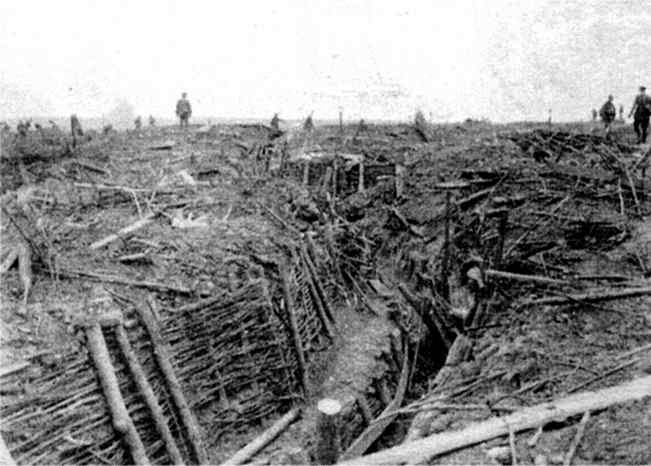
Five days later the 2nd Australian Division suffered heavily in a further attack in the mud. Finally, on 12 October, another attack, involving the 3rd Division assisted by the 4th, was made against the village of Passchendaele atop the main ridge. In the face of heavy fire, the men fought in the mire while struggling to keep up with their artillery barrages. Ground was taken but it could not be held. In wretched conditions, with casualties mounting at an appalling rate, the Australians had to fall back. 

The troops were finally exhausted and could do no more; by 15 November they handed over to the Canadians.


image above:
main image is of Reginald Percy Bartram

top right:
Machine gunners of the 4th Australian Division, Garter Point, 


Ypres, Belgium, 27 September 1917.

second from top:
Dead and wounded Australians and Germans 


in the railway cutting on Broodseinde Ridge, 
in the Ypres sector, Belgium, during the battle of Passchendaele.

lower right:
Broodseinde with four German shells exploding near the Australian trenches


The following image is of the Red Cross Missing in Action Cards from members of Reginald's Battalion in the hopes of identifying where he was buried.

*Bartram was killed by a shell which went right through him in Passchendaale.

*I was in the same advance. A shell exploded near casualty, killing him instantly.

*I did not see casualty killed, but I saw his body the same afternoon as I was going for water.

*He was at the Menin Road on 4th October, we attacked at daybreak. Bartram was laying in a shell hole on "no mans land".


above image
YPRES (MENIN GATE) MEMORIAL,
 Ieper, West-Vlaanderen, Belgium

 Panel 7 - 17 - 23 - 25 - 27 - 29 - 31

Bartram Reginald Percy
K.I.A Thursday, 4th October 1917
    36yrs
Son of George Andrew and Isabella Bartram;
husband of Lucy M. Bartram.
Native of Richmond, Victoria.


........................................................................
I have often thought that many a youngster when he was hit out there 
on the Passchendaele heights and he knew that the end had come,
must have thought to himself:

“well at least they’ll remember me in Australia”.

C.E.W. Bean


Charles Edwin Woodrow Bean 
(18 November 1879 – 30 August 1968), 
usually identified as C.E.W. Bean
was an Australian schoolmaster, judge's associate, barrister  
journalist, war correspondent and historian.
Bean is renowned as the editor of the 12-volume
Official History of Australia in the War of 1914-1918
. Bean wrote Volumes I to VI
himself, dealing with the 
Australian Imperial Force at Gallipoli, France and Belgium. 
Bean was instrumental in the establishment of the Australian War Memorial
and of the creation and popularisation of the ANZAC legend.

the three BARTRAM brothers were all killed in 1917


Reginald Percy BARTRAM d. 04 Oct 1917 Belgium

click on each of the brothers for the blog posting
and a cousin of "The Bartram Brothers"

- Leslie Norman Krause -
we will remember them


UPDATE: 7th October 2013:
with further research have located some information on the two surviving sons of Reginald Percy BARTRAM.


Ernest George BARTRAM was born in Brunswick in 1906. In May 1921, according to the letter from Evelyn Bartram, Ernie Bartram was 'traveling' at the time the Army wanted to pass on his fathers medals. So perhaps he did not receive his fathers medals.

In the Electoral Rolls of 1937, I located one Ernest George BARTRAM as residing at 64 Union St, Prahran. But this is NOT CONFIRMED as being the same person.

In the Electoral Rolls of 1980, I located one Ernest George BARTRAM as residing at 17 Langston St, Bendigo. But this is NOT CONFIRMED as being the same person.

no further information on Ernest George BARTRAM has come to hand.

Reginald Arthur BARTRAM was born in Brunswick in 1908. I have not had much success in locating any information on him, but on checking the Electoral Rolls of 1937 I see a person by the name of Reginald Arthur BARTRAM residing on his own at 6 Alison Rd, Caulfield West. Then In 1980 a person by this name is residing alone at 8 Laburnum St, Blackburn.

So went back to the 1949 Electoral Roll and see a Reginald Arthur BARTRAM residing with a person by the name of Marcelle Louise BARTRAM.  I checked on this person and note that she was born in Malvern on 26 Aug 1909 and died at Blackburn on 26th April 1974.

There is NO CONFIRMATION that the Reginald Arthur BARTRAM is the same as the one I am looking for.

Admittedly the name BARTRAM is not common, and I doubt there would be anyone else by this name in Victoria, Australia.
But until I can confirm it, will leave it here to be noted only.


with grateful thanks to Robert Matthews for the extra help and guidance!

and to the National Archives and the
Australian War Memorial
for the data that is on their websites that is
invaluable to all genealogists.


UPDATE 22nd July 2014:
Reginald Percy Bartram's name will be projected onto the exterior of the Hall of Memory at the AWM in Canberra on:

  • Thu 14 August, 2014 at 8:07 pm
  • Sat 27 September, 2014 at 10:41 pm
  • Wed 19 November, 2014 at 8:55 pm
  • Tue 13 January, 2015 at 8:39 pm
  • Sat 7 March, 2015 at 12:59 am
  • Wed 22 April, 2015 at 3:47 am
  • Tue 2 June, 2015 at 11:27 pm
  • Fri 10 July, 2015 at 6:04 am

These dates and times are estimates. The actual time of projection could change as a result of weather and other factors, so it is advisable to check closer to the date. In the rare event of a temporary loss of electrical power, the names scheduled for display in that period will not appear until the next time listed.


...................................


Sep 24, 2014

William Stanley ORMANDY [1883 - 1917]


William Ormandy was born in Macarthur in June 1883, Macarthur is 66 klms NE of Portland, in the south west area of Victoria, Australia.

His parents were George Samuel ORMANDY and Grace LINDSAY who were married at Branxholme in December 1865. George was born in Lancashire, England and Grace was born in Stirlingshire, Scotland.

I know little of William Stanley Ormandy, certainly no one in the family has passed on any information that I know of, so have taken most of the information of his life whilst in the AIF from his attestation papers and from the 4th MGC diaries available through the NAA (National Archives of Australia) and the AWM (Australian War Memorial) websites.


Description Circular colour patch for 4 Division Machine Gun Company and 24 Australian Machine Gun Company, AIF, showing a central white circle on a black background, below which are two crossed guns in yellow. Summary Worn as a distinguishing unit indication at the head of each sleeve from 1917. The two crossed guns were the patch of the Machine Gun Corps, although they was not worn by machine gun squadrons allotted to the Light Horse brigades.

On the 29th September 1916 William enlisted in the AIF with the 4th Machine Gun Company with service number 560.  He embarked Melbourne on board the HMAT ORSOVA on 6th December 1916 bound for Plymouth, England where he arrived in February 1917


HMAT ORSOVA

After some months of training in England he proceeded to France on board the PRINCESS VICTORIA, but just four days after his arrival at Boulogne he was admitted to hospital with German Measles and did not rejoin his unit again until 22nd May 1917.

30 May 1917

The 4th MGC proceeded to the reinforcement camp at Morbecque in the north of France.

7 June 1917

The Battle of Messines Ridge
.


and from the AWM (Australian War Memorial) site:

Successful British assault on the Messines-Wytschaete Ridge, a strongly held strategic position on the Western Front, which had been held by the Germans since late 1914. The offensive operation was the product of long preparation, detailed planning and sound training carried out by General Plumer's Second Army. The initial assault was preceded by the detonation of 19 mines under the German font line which caused an estimated 10 000 German casualties. British, Australian and New Zealand infantry advanced behind a carefully co-ordinated artillery bombardment and took all their objectives within the first hours of the battle. German counter attacks the following day failed, and although German resistance continued until 14 June, British, Australian and New Zealand forces retained possession of the captured areas. The battle is often cited as a model for a well planned limited objective attack. Messines represented a preliminary to the major British offensive in Flanders in 1917, the Third Battle of Ypres.


8 June 1917

Now at Messines Ridge, Belgium. Image shows the Officers of the 4th Machine Gun Company eating breakfast in a reserve near Messines during the Battle of Messines which started on 7th June.  These men moved to the front line after dark.

9th June 1917

instructions given to the 4th MGC to relieve the 1st NZ Machine Gun Company in the Messines Sector.


13 June 1917

The above image shows members of No. 1 Section, 4th Australian Machine Gun Company, in a front line trench approximately one kilometre south east of Messines. The Company fought here from 9 to 14 June 1917 (Battle of Messines)


9 July 1917

William was admitted to hospital - in field - with septic abrasion to the buttock. One week later on the 16th July he rejoined his unit.


29 August 1917

still at Ploegsteert Woods, Belgium and all men given morning off to tidy themselves up and bath themselves. Afternoon cleaning of all gun gear & packing & cleaning of wagons.


1 September 1917

The morning was devoted to the care of the mens feet - a foot inspection being held by section officers and attention being paid to socks. Billets were cleared & gun gear & wagons packed ready. The next morning (2nd September) the men were embussing at 9:00am at Merville. Arrived at Lisbourg about 3.00pm and marched to Crepy where they were billeted with 16th Battalion.


13 September 1917

By the 13th they were at Fruges, Pas-de-Calais, Nord-Pas-de-Calais, France where this group image (above) was taken of 4th Machine Gun Company.


18 September 1917

The Company fell in at 8.45am & marched to Crepy. From there they proceeded in buses to the vicinity of Staple, near Hazelbronck. On 20th the Company moved off at 8.30am for Steenvoorde area & arrived in Billets there at about 3.00pm. Next day orders were received to embus for Canal area, near Ypres.

23 September 1917

at Westhoek Ridge, Belgium

Headquarters and the two sections left Belgian Chateau at 3.00pm for 7th Australian MGC Headquarters at Westhoek Ridge, the route being through Ypres & along the Ypres-Menin Road.

yellow line shows location of Westhoek Ridge east of Ypres

Windy outpost on Westhoek Ridge ~ Belgium

24th September 1917

Preliminary Orders for the offensive which is to take place shortly were issued this afternoon. A barrage was put over by our artillery at 8.00pm. There was a fair amount of retaliation from the enemy.

25th September 1917

Memo received from Rear Battalion Headquarters that attack will take place on “K” Day which is tomorrow, 26th Inst. Zero hour 5:50am.

The Brigadier thinks that 3.00am is too early to be on the jumping off tape but that at the same time the tails of Battalion should be clear of present support line ….


26 September 1917

The Battle of Polygon Wood.

~from the diary of the 4th Machine Gun Company ~
we can only assume that William Stanley Ormandy
was one of the "two men in front line have been killed"

The attack commenced at 5.50am 26 September, 1917 with the Australian 4th and 5th Divisions and 5 British divisions following an artillery barrage on a 10 kilometre front. The Australian 4th and 5th Divisions were responsible for a front of about 2,500 metres. All northern objectives were taken while on the southern front captured all their objectives as well as some objectives assigned to X Corps. One of the main objectives was Polygon Wood Butts, which in peacetime was the Ypres district rifle range. From the Butts the Germans commanded an excellent view of all targets with their machine guns. This was also taken.

This was designed as the second blow of the Ypres battle. Casualties on both sides were about equal. The Australian 4th Division captured all its objectives and sustained 1,717 casualties. The more heavily engaged Australian 5th Division suffered 5,471 dead and wounded. The Allied forces were now in a position to strike at the main Broodseinde ridge.

KIA - 26 September 1917


the will - in part - of William Stanley Ormandy

Polygon Wood is a small wood which is about four miles east of Ypres. The wood was sometimes known as Racecourse Wood, as there was a track within it. Before the Great War, Polygon Wood was by the Belgian Army and within it stands a large mound, known as the Butte, which was used for musketry training. On the Butte today stands a memorial to the 5th Australian Division.

During the War, Polygon Wood was totally destroyed, and the wood was replanted after the war. There are 'rides' or tracks running through the wood which can be walked, and in terms of the Great War, there is a large cemetery, plus a New Zealand Memorial to the Missing as well as the Australian Memorial within the wood itself. Just outside the wood is a small original wartime cemetery. In fact, the entrances to the two sites are directly opposite on either side of the road, at the north-eastern apex of the wood.

Commemoration details The Ypres (Menin Gate) Memorial (Panel 31), Belgium


LEST WE FORGET


Roll of Honour name projection.

William Stanley Ormandy's name will be projected onto the exterior of the Hall of Memory (AWM) in Canberra on:


  • Fri 24 October, 2014 at 5:39 am
  • Wed 17 December, 2014 at 5:38 am
  • Tue 10 February, 2015 at 3:02 am
  • Wed 1 April, 2015 at 11:42 pm
  • Wed 13 May, 2015 at 8:27 pm
  • Mon 22 June, 2015 at 1:59 am
  • Wed 29 July, 2015 at 6:56 pm

These dates and times are estimates. The actual time of projection could change as a result of weather and other factors, so it is advisable to check closer to the date. In the rare event of a temporary loss of electrical power, the names scheduled for display in that period will not appear until the next time listed.


With grateful thanks to the following for information and the use of images & data off their sites:


another family member, Arnold Roy Bartram 
and not related to William Ormandy, 
also embarked Melbourne on board the HMAT ORSOVA!


read about Arnold HERE


.
,


Aug 25, 2014

George Bowden HUDSON [1891 - 1982]


George Bowden Hudson was the sixth child of William Charles Hudson and his wife, Matilda Ellen King.

George was born in Moama in New South Wales (Australia) on 8th October 1891. War broke out when George was 22 years of age, but it was not until July 1915 that he enlisted at Echuca in the 31st Battalion and given service number 710 in the AIF.


He completed his training at Broadmeadows Camp in Melbourne before departing Melbourne on board the HMAT A62 WANDILLA on 9th November 1915 bound for the Middle East. The Battalion arrived at Suez on 7th December 1915.


Unit embarked from Melbourne, Victoria, on board
HMAT A62 Wandilla on 9 November 1915

16th March 1916 - Innoculations “C” Company – 1st dose typhoid and paratyphoid. 1st Parade on bayonet fighting and physical training 2nd Parade on company training under OC companies 3rd Parade on half holiday.


The 31st Battalion continued with physical training and bayonet fighting and were in the Middle East until June 1916 when it departed for Marseilles in France.  By 1st July they were at Morbecque and being put through a practical demonstration of poisonous gas and gas helmet instruction.

Morbecque in France

9th July - 1030-1430: Battalion left Estaires 1000 hours and Brigade starting point 1030. Destination Erquinghem via Croix du Bac, Bac St Maur. Bn met at Croix du Bac by guide & led to billets in Rue Dormoire abt 1 mile west of Erquinghem, relieving the 18th Bn.

16th July - First of Battalion arrived at Fleurbaix (Bois-Granier Line, France) about 1430 to find billeting arrangements inadequate and incomplete. It took some time to make suitable arrangements and it was 0430 hours before last of the men were billeted.


19th July - The 31st Battalion fought its first major battle at Fromelles on 19 July 1916, having only entered the front-line trenches 3 days previously. The attack was a disastrous introduction to battle for the 31st - it suffered 572 casualties.

20th July -
0545: Captured positions could not be held so a retirement was made at 0545 back to our own lines. Very heavy casualties and men completely broken. 0900: Battalion taken out of front line and re-billeted at Fleurbaix. Estimated casualties 600 of all ranks.


parts of the 31st Battalion War Diary reads as ........


To have a much better understanding of what the Diggers went through at Fromelles - and in particular the 31st Battalion - it is perhaps wise to read the diaries of the 31st Battalion

The following are just six pages of Appendix C from the diary dated 19th July 1916.


By the first week of August, George Hudson was back at Fleurbeaux in France. The Bn diary - for the 3rd August - reads as: Situation quiet. Few parties of enemy noticed behind enemy lines but in general troops well under cover. Battalion growing much more cheerful after grueling of 19 and 20 July 1916 ultimo. Foggy weather prevails in the mornings.
31 August - La Motte, France.

Battalion under canvas at La Motte. Small replica RF 1/110 of Bois des Vaches built in camp area for lecture purposes.

21 September -
Armentieres, France.


Day fine but roads in bad condition. Arrived Armentieres at 10.40am & settled in billets at 11am. Brigade notified. very bad condition, mud plentiful bags in parapet and communication trenches rotten and walls tumbling in.

when reading through the diaries, it seems most days the weather & conditions were intolerable....


30th October - Montauban, France.

Very wet and mud conditions simply indescribable. Horses tractor engines stuck everywhere on the roads. Majority of roads being laid with logs in transverse section.


One year later after spending much of their time around the Somme area, 
the Battalion arrived at Wippenhoek, in Belgium on
19th September.

25 September 1917 -
Warning Order received from Brigade that Battalion to be held in readiness to move at short notice. 10.00 pm: Battalion moved off to front line to take part in the horrendous Battle of Polygon Wood.

The 31st fought in the Ypres sector. The battle began at 5.30 am on 26 September 1917, when the British and Dominion guns opened on a 10 kilometre front. The intention was to build on the gains made during the Battle of Menin Road. The AIF 4th and 5th Divisions were responsible for a 2500-metre sector and one of their main objectives was Polygon Wood Butts, the target on the Ypres district rifle range.


"the 4,000 men of the six attacking battalions dashed forward at a run ........
George Bowden Hudson was one of those men in the 5th Division.
Ypres - 1917

2nd May 1918 - at Bois d'Accroche, Le Hamel, France

by the 2nd May 1918 the Battalion were at this location.
Bois d'Accroché, Le Hamel, France

13th May 1918 - Wounded in Action.

wounded in action - gassed. According to the Bn diary the Artillery was active during the day. "Suggest" that he was wounded at Vaire, Le Hamel, France.


Poison gas was probably the most feared of all weapons in World War One. Poison gas was indiscriminate and could be used on the trenches even when no attack was going on. 

Whereas the machine gun killed more soldiers overall during the war, death was frequently instant or not drawn out and soldiers could find some shelter in bomb/shell craters from gunfire. A poison gas attack meant soldiers having to put on crude gas masks and if these were unsuccessful, an attack could leave a victim in agony for days and weeks before he finally succumbed to his injuries.

Gassed Australian soldiers awaiting treatment near
Bois de L'Abbe outside Villers-Bretonneux 1918.


Location of where George Hudson was wounded

George Bowden Hudson returned to Australia on 8th April 1919 and in 1923 he married Inez Emily Henderson. Daughter of John Gill Henderson and Mary Margaret Simpson.


On the 12th August 1982 George died in Deniliquin at the age of 90 years. He is buried at the Mathoura Cemetery along side his wife - Inez - who died in 1979.


with grateful thanks to the following 

for use of data and images


the above information on George Bowden Hudson has been collected over many years, but if anyone has any further data I would be more than happy to hear from you!

George Hudson is my first cousin (2 x removed)

we relate through my great great grandmother:
Elizabeth Jane RICHARDS
[1837 - 1919]


LEST WE FORGET


.


Jul 23, 2014

James Herbert Clegg [1891 - 1917]


Joseph Clegg and Elizabeth Parr married in Victoria, Australia in 1875 and soon started their large family. First along came Alice in 1876 and then in quick succession came seven others before James Herbert Clegg came on the scene in June 1891 when they were living at Wandin Yallock.

The Clegg family were considered one of the Pioneer Families of the Silvan District and much is written about them from their early days in that area.

Young James had only just turned four years of age when his mother died in August 1894.


James Herbert Clegg enlisted in the AIF on the 3rd July 1915 at Melbourne and listed his father - Joseph Clegg - as his Next of Kin.  He was given the service number 3279.

Just 3 mths later he embarked Melbourne on board the HMAT NESTOR bound for Egypt.


As part of the 46th Battalion, James arrived in France on 8th June 1916 and was destined for the Western Front. A couple of weeks later was at Sailly-le-Sec in France fighting in the trenches alongside his mates of the 46th Battalion.


It is needless to say the trauma these Diggers went through as we have read many books and seen much of their suffering during the horrific time of WW1. I doubt even the photos show any of us how traumatic their lives must have been with injuries and illness amongst the troops during this time.


By August 1916 the 46th Bn was participating in its first major battle of WW1 - The Battle of Pozieres. Initially the Battalion provided carrying parties for supplies and ammunition during the 2nd Divisions attack on 4th August and then, with its own division, defended the ground that had been captured.

It was here on 30th August - during the Battle of Pozieres - where James was wounded with Shell Shock. He remained in hospital for one month and discharged from hospital in early September.


On 15th September and again on 24th October 1916, James was on Parade "unshaven" and for these crimes he was charged a days pay for each crime.

While at Rouen in Haute Normandie in France, James was admitted to Hospital with influenza and eventually transferred to England for a long recuperation period.  It was not until March the following year that he was eventually discharged from hospital and transferred to the 65th Battalion for a period of time, perhaps for further training.

In the meantime, on the 11th April 1917, his original 46th Battalion took part in the attack mounted against the heavily defended village of Bullecourt - part of the formidable Hindenburg Line to which the Germans had retreated during February and March.   


By the 22nd May 1917, when James was at Wareham in  England his superiors had him transferred back to the 46th Battalion once again and he found himself back in Belgium!

From the 7th June to the 14th June 1917 the Battle of Messines (Belgium) took place.
The primary objective of this particular battle was the strategically important Wyschaete-Messines Ridge, the high ground south of Ypres. 


Messines Ridge

Two weeks later, the 46th Battalion was located at Ploegsteert Wood and where the major battle on Hill 63 took place as part of the Battle of Messines.


A dummy tree used as an observation post on Hill 63 by Australian troops during the battle of Messines in June 1917


Hill 63 as it is today and where James Herbert Clegg was KIA.

Messines was the first time Australians and New Zealanders had fought side by side since the Gallipoli campaign of 1915.

and it was here - on Hill 63 - that James Herbert Clegg was Killed in Action.


His personal effects of a wallet, diary, handkerchief and photos were returned to his father in Australia on board the "Barambah".


James was buried at the Underhill Farm Cemetery, Ploegsteert in Belgium.


James Herbert Clegg

[1892 - 1917]

Lest We Forget


Underhill Farm Cemetery


The following family members were attached to the 
46th Battalion and prior to WW1 
were unknown to each other.

Raymond Everard Bartram....... KIA 07 June 1917

Ernest Cockbill Kendrick .......... KIA 05 April 1918

James Herbert Clegg ............... KIA 02 July 1917

all three fought in the 

Battles of Pozieres, Messines, and Sailly-le-Sec

This website will be of interest to those with any family member that fought at Pozieres:

Pozieres Memorial Park


James Herbert Clegg's name will be projected onto the exterior of the Hall of Memory at the AWM in Canberra on:

  • Sun 17 August, 2014 at 2:12 am
  • Tue 30 September, 2014 at 4:46 am
  • Sat 22 November, 2014 at 9:25 pm
  • Fri 16 January, 2015 at 10:09 pm
  • Mon 9 March, 2015 at 11:59 pm
  • Fri 24 April, 2015 at 8:17 pm
  • Fri 5 June, 2015 at 1:22 am
  • Sun 12 July, 2015 at 6:19 pm
These dates and times are estimates. The actual time of projection could change as a result of weather and other factors, so it is advisable to check closer to the date. In the rare event of a temporary loss of electrical power, the names scheduled for display in that period will not appear until the next time listed.


with grateful thanks to the AWM (Australian War Memorial) and NAA (National Archives Australia) 
for the above information and some of the images.


.