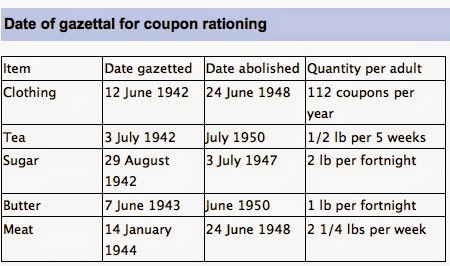
Previous blog post was on CLOTHING RATIONS and this one is a little about the FOOD RATIONING during World War 2.
The State Library of Victoria has an article on this subject amongst their History Research area here.
In Australia, the war did not only affect those men and women who went to fight and serve abroad. Many things also had to change for those who remained at home.
Many men left their jobs to join the armed forces leading to a shortage of labour. New industries had to be created to supply the troops with weapons, uniforms and ammunition . The government had to control the buying and selling of scarce goods, to ensure that everyone received a fair share.
Australians began to experience shortages of almost everything they needed in daily life. At the time of World War II, most of them drank tea, not coffee. When the Japanese captured many of the countries that grew the tea supplied to Australia, this caused severe shortages. Enemy action in the Pacific also disrupted the normal supply of goods by ship to Australia. Australian troops abroad had to be supplied with food produced in Australia, and when thousands of American troops arrived in Australia to fight the war in the Pacific, they also had to be fed.
To ensure that everyone received a basic amount of essential supplies such as meat, butter, sugar and tea, the government brought in a system of rationing. Everyone had to apply for ration books, which contained a number of coupons. Each coupon gave the holder permission to buy a certain amount of something, usually over a weekly period. Despite the hardship, rationing was well received by the public because it applied to everyone equally. Nevertheless, when the government announced in May 1942 that they would impose rationing on clothing, there was a rush to buy as much as possible before rationing began.
Petrol rationing was first enforced in Australia in October, 1940, a little more than twelve months after the commencement of the 1939-45 War.
No very drastic cuts in consumption were made for some time, but, commencing in April, 1941, when the replenishment of stocks from overseas supply sources was becoming increasingly difficult and uncertain, progressive reductions in the monthly allowances to civilian users were made, the basic ration being finally reduced to the equivalent of only 800 miles of running per annum.
The period of severest rationing lasted from late in 1941 until towards the end of 1944, non-military consumption during these three years or thereabouts being at a rate not very much in excess of one-third of the estimated pre-war rate of 30 million gallons per month.
another article about the Food, Clothing & Petrol Rationing can be found here on the Australian Bureau of Statistics website.
Museum Victoria also contains a lot of excellent information regarding the Food Rations.
the above Food Ration Cards were issued to:
Frederick William James ROBERTS [1900 - 1972]
May Eileen Rose ROBERTS (nee NORMAN) [1900 - 1985]
and their two sons:
Ronald Frederick ROBERTS and Dennis ROBERTS
with thanks to the Australian Bureau of Statistics and the State Library of Victoria for the above valuable information.
Many men left their jobs to join the armed forces leading to a shortage of labour. New industries had to be created to supply the troops with weapons, uniforms and ammunition . The government had to control the buying and selling of scarce goods, to ensure that everyone received a fair share.
Australians began to experience shortages of almost everything they needed in daily life. At the time of World War II, most of them drank tea, not coffee. When the Japanese captured many of the countries that grew the tea supplied to Australia, this caused severe shortages. Enemy action in the Pacific also disrupted the normal supply of goods by ship to Australia. Australian troops abroad had to be supplied with food produced in Australia, and when thousands of American troops arrived in Australia to fight the war in the Pacific, they also had to be fed.
To ensure that everyone received a basic amount of essential supplies such as meat, butter, sugar and tea, the government brought in a system of rationing. Everyone had to apply for ration books, which contained a number of coupons. Each coupon gave the holder permission to buy a certain amount of something, usually over a weekly period. Despite the hardship, rationing was well received by the public because it applied to everyone equally. Nevertheless, when the government announced in May 1942 that they would impose rationing on clothing, there was a rush to buy as much as possible before rationing began.
Petrol rationing was first enforced in Australia in October, 1940, a little more than twelve months after the commencement of the 1939-45 War.
No very drastic cuts in consumption were made for some time, but, commencing in April, 1941, when the replenishment of stocks from overseas supply sources was becoming increasingly difficult and uncertain, progressive reductions in the monthly allowances to civilian users were made, the basic ration being finally reduced to the equivalent of only 800 miles of running per annum.
The period of severest rationing lasted from late in 1941 until towards the end of 1944, non-military consumption during these three years or thereabouts being at a rate not very much in excess of one-third of the estimated pre-war rate of 30 million gallons per month.
another article about the Food, Clothing & Petrol Rationing can be found here on the Australian Bureau of Statistics website.
Museum Victoria also contains a lot of excellent information regarding the Food Rations.
the above Food Ration Cards were issued to:
Frederick William James ROBERTS [1900 - 1972]
May Eileen Rose ROBERTS (nee NORMAN) [1900 - 1985]
and their two sons:
Ronald Frederick ROBERTS and Dennis ROBERTS
 |
| ROBERTS family outside their home at St Kilda in 1934 |
with thanks to the Australian Bureau of Statistics and the State Library of Victoria for the above valuable information.
.