Showing posts with label Pozieres. Show all posts

Jul 25, 2014

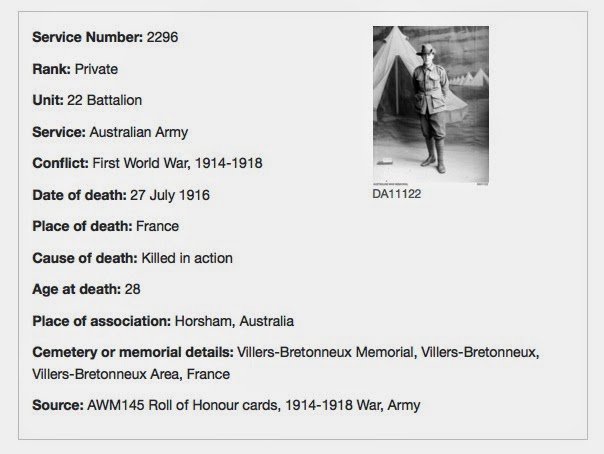
Donald William McTAVISH 1888 - 1916


Donald William McTAVISH  was born in 1888 in Horsham, Victoria, Australia, the third child for Donald McTAVISH and Anne CHANDLER.

At the age of 27 years, Donald - a farmer - enlisted in the AIF on 24th July 1915 to the 22nd Battalion 4th Reinforcement with service number 2296. He enlisted the same time as his cousin - Harold McTAVISH who was given the service number 2295.


The following is a group image of the 22nd Battalion prior to departure for overseas, date and place taken is unknown.


After their training, both Donald McTavish and his cousin Harold embarked at Melbourne on 27th September 1915 on board the HMAT HORORATO. Bound for the Middle East via Fremantle.
Unfortunately, Donald failed to re embark the Hororato in Fremantle and had to wait for the HMAT Osterley departing on 5th October.

HMAT Hororato

HMAT Osterley

The 22nd Battalion spent some time in Moascar in Egypt with field training.


In March 1919, George Lambert described the Moascar camp as: "Miles and miles of tents and desert, thousands of sweating, sun-bronzed men and beautiful horses"(Lambert 1938, p. 79).

On 20 July 1919 he wrote to his wife: "... the well-appointed camp that two years ago spread out from here to the Desert for miles and umpteen miles, a white city of tents. There are still tents, a mile or so ... but the tents are slowly coming down, the incinerators are throwing off long, low lines of blue smoke ... Outside this bit of shade, 111 Fahrenheit, there is a blaze of almost colourless light, and it takes even for an experienced savage like myself, a few seconds to locate the difference between sand, tents and sky. In this blaze work still goes on - army work ...".

On the 19th March 1916 they departed Alexandria on board the LLANDOVERY CASTLE bound for Marseille, in France.


In March 1916, the 22nd Battalion embarked for France and experienced their first service on the Western Front in reserve breastwork trenches near Fleurbaix at the end of the first week of April 1916. The battalion’s first major action was at Pozières, part of the massive British offensive on the Somme.


By the first week of July in 1916 they were in the Bois Grenier Line, near Steenwerck in France.  From there they were entrained towards Lealvillers and by the third week of July marching towards Albert.

The Bois Grenier Line - a support trench - was about 70 yards to the rear of the front line and then a further 1000 yards back was the reserve line.

Australian soldiers on their way to the front-line trenches at Bois Grenier, 5 June 1916

An Australian soldier in the trenches near Bois Grenier, 5 June 1916

Australians in the trenches near Bois Grenier, 3 June 1916

22nd Battalion in France

By the 26th July 1916 they were on march from  Lealvillers to Albert.... at 5.30pm the Battalion moved off passing thru Albert to Sausage Valley where the Battalion was issued with picks, shovels, two mills bombs each and two sandbags. At 11pm Battalion moved off to relieve 6th Battalion AIF in POZIERES.


at 4.30am on 27th July 1916 they were occupying trenches in Pozieres. Enemy shelling commenced at 6.30am in response to the Battalion artillery fire. Shelling was intense. On this day, in the 22nd Battalion, 21 KIA, 19 MIA, 129 wounded.


Battle of Pozieres ~ one year and three days from time of enlistment. Army records state that Donald William McTAVISH died between 27th July and 4th August. (4th Aug was when his cousin was severely injured) But his death was always remembered as being on 27th July each year.


View across the Pozières plateau in August 1916

22nd Battalion Cross Erected at Pozieres

Donald William McTavish is remembered with honour at
Villers-Bretonneux Memorial

No known grave


Donald William McTavish is remembered at the 
Australian War Memorial.


Australian National Memorial, Villers-Bretonneux, France

Villers-Bretonneux is a village about 15 km east of Amiens. The Memorial stands on the high ground ('Hill 104') behind the Villers-Bretonneux Military Cemetery, Fouilloy, which is about 2 km north of Villers-Bretonneux on the east side of the road to Fouilloy.

The Australian National Memorial, Villers-Bretonneux is approached through the Military Cemetery, at the end of which is an open grass lawn which leads into a three-sided court. The two pavilions on the left and right are linked by the north and south walls to the back (east) wall, from which rises the focal point of the Memorial, a 105 foot tall tower, of fine ashlar. A staircase leads to an observation platform, 64 feet above the ground, from which further staircases lead to an observation room. This room contains a circular stone tablet with bronze pointers indicating the Somme villages whose names have become synonymous with battles of the Great War; other battle fields in France and Belgium in which Australians fought; and far beyond, Gallipoli and Canberra.

On the three walls, which are faced with Portland stone, are the names of 10,885 Australians who were killed in France and who have no known grave. The 'blocking course' above them bears the names of the Australian Battle Honours.

After the war an appeal in Australia raised £22,700, of which £12,500 came from Victorian school children, with the request that the majority of the funds be used to build a new school in Villers-Bretonneux. The boys' school opened in May 1927, and contains an inscription stating that the school was the gift of Victorian schoolchildren, twelve hundred of whose fathers are buried in the Villers-Bretonneux cemetery, with the names of many more recorded on the Memorial. Villers-Bretonneux is now twinned with Robinvale, Victoria, which has in its main square a memorial to the links between the two towns.

Donald William McTavish's name will be projected onto the exterior of the Hall of Memory at the AWM in Canberra on:
  • Tue 19 August, 2014 at 5:17 am
  • Thu 2 October, 2014 at 11:15 pm
  • Tue 25 November, 2014 at 4:30 am
  • Mon 19 January, 2015 at 8:38 pm
  • Thu 12 March, 2015 at 6:03 am
  • Sun 26 April, 2015 at 10:01 pm
  • Sun 7 June, 2015 at 12:17 am
  • Tue 14 July, 2015 at 6:54 am
These dates and times are estimates. The actual time of projection could change as a result of weather and other factors, so it is advisable to check closer to the date. In the rare event of a temporary loss of electrical power, the names scheduled for display in that period will not appear until the next time listed.


With grateful thanks to:

The Australian War Memorial
The Australian National Archives
Australians on the Western Front


for further information and the use of their images off their sites.

LEST WE FORGET


.


Jul 21, 2014

Arthur Geraldton HIGGS - 1894 - 1916


Arthur Geraldton HIGGS was born in Armadale on 6th October 1894.

He was the son of John Thomas Higgs [1860 - 1932] and Sarah Ann Norman [1857 - 1923]
John and Sarah married in Toorak in October 1881 and had seven known children. All of them being born in Victoria until  the last child - Hazel Gladys Higgs - who was born in Western Australia in 1899.

Arthur first enlisted at Drouin in December 1914 but after training with the 13th Light Horse Regiment he was discharged as medically unfit in May 1915.

In July 1915, Arthur Geraldton Higgs re-enlisted in the AIF in Perth, Western Australia, allocated to the 11th Battalion (9th reinforcements) and was given the service number of 2778. At this time his parents were living in Belgrave, Victoria.


Arthur was described as being 24 years & 9 mths of age, was 5 feet and 11 inches tall and weighed 184 lbs. He had a fair complexion, blue eyes and auburn hair.  He had a scar on his right thumb and his occupation was that of a farmer.

At his medical examination on 28th September 1915 at Blackboy Hill in Perth, he was declared fit for active service and so was ready to follow his brother - Harold Henry Higgs - who enlisted in the AIF in August 1914 - to Europe.


above: H.M.A.T. HORORATA.


October 1 1915

Embarked at Fremantle on H.M.A.T. HORORATA

January 5 1916
on board "EMPRESS OF BRITTAIN" arrived off Alexandria at 0800, entered harbour and berthed at 1400. Disembarked and entrained at 1930 for Kel-el-Kebir......

March 15 1916
appointed Lance-Corporal

March 30 1916
at Alexandria, Battalion sailed for Marseilles.

May 20 1916
At Sailly-Sur-Lys, France, the Battalion less transport moved into the firing line with 27 Officers, 929 OR (Other Ranks)...

June 1 1916
at the front line, enemy quiet, but a few bombs were sent into our lines.....

July 10 1916
At Meteren. The Battalion received orders to entrain at Godewaersvelde at 4.53am on 11th July, destination at that time was unknown.....

July 18 1916
At Rubempre, Battalion plus first line transport moved to Forceville until 4.00pm 19 July.....

July 19 1916
At Forceville. The Battalion moved via Albert to the firing line at Pozieres section and took over from one company of the Durham Light Infantry.....

July 22 1916
"On the night of of 22/23 the 11th Battalion, in co-operation with the 9th Battalion on the right and the 1st Australian Infantry Brigade on its left and supported by the 12th Battalion, attacked the enemy before Pozieres"


For three days, 24 to 26 July 1916, the Germans relentlessly bombarded Pozières. The aim of this concentrated shelling was not simply to prepare for a counter–attack but to inflict as much damage and loss on the Australians as possible. Also shelled were the approaches to the village, by which vital supplies entered and hundreds of walking wounded and stretcher–bearers carrying the severely injured exited. 


One of these approaches was the ‘sunken road’, which reached Pozières from the countryside to the south–west on the other side of the main road just opposite First Australian Division Street. Enemy shells rained down on the village’s main street and along the ‘sunken road’ for most of 24 July. 


above: the Battle of Pozieres - 1916

"Our casualties during the operation were: 68 killed 369 wounded and 92 missing".

In this inferno the ‘sunken road’ became known as ‘Dead Men’s Road’. Bodies lay along its flattened banks; trees were uprooted and turned into stumps; over everything lay the dust of explosions. Such situations can bring out the best in men and one who came to the fore was Private Edward Jenkins, age 44, a 3rd Battalion stretcher–bearer. On his enlistment papers in 1915 he had described himself as a ‘bushman’ and Charles Bean described Jenkins as ‘one who had constantly been in hot water when out of the line’. 

During the worst of the bombardment on 24 July Jenkins was observed constantly caring for the wounded with the ‘uttermost tenderness’, giving them the last of his water, refusing water himself when it was brought up so that the wounded could have it, raising little shelters for them and trying to remove them safely out of danger. Captain James Harris, 3rd Battalion, felt Jenkins saved many lives that day and that all of those he rescued were safely evacuated and lived.
 

That evening, Jenkins himself ‘when taking a dixie of tea to the sufferers’ was blown to pieces by a shell.


Most of the men of the 11th Battalion who died under the German bombardment of Pozières on 25 July 1916 – 48 soldiers – were never found.

Their names are commemorated on the walls of the Australian National Memorial at Villers–Bretonneux but their remains lie somewhere in the soil to the north–east of modern day Pozières.


Arthur Geraldton Higgs was killed in action sometime between the 22nd and 25th July in 1916, and was one of the 48 men of the 11th Battalion that was never found.


Wed 25 July 1917 in the Argus newspaper

HIGGS,- In loving memory of Lance Corporal

Arthur Geraldton Higgs who was killed in action in France July 25 1916 youngest dearly loved son of John and Annie Higgs and loved brother of Eva (Mrs. McKernan) Richard, George. Harold (on active service) and Hazel.

His King and country called him. 

The call was not in vain

On Australia's roll of honour 

You will find dear Arthur's name

He nobly did his duty.

(Inserted by his loving parents, brothers and sisters ) (West Australian papers please copy )


image taken at the AWM in Canberra - Oct 2013


LEST WE FORGET

Arthur Geraldton Higgs' name will be projected onto the exterior of the Hall of Memory at the AWM on:

  • Sat 16 August, 2014 at 1:01 am
  • Mon 29 September, 2014 at 3:35 am
  • Fri 21 November, 2014 at 3:50 am
  • Thu 15 January, 2015 at 3:53 am
  • Sun 8 March, 2015 at 9:18 pm
  • Thu 23 April, 2015 at 7:46 pm
  • Thu 4 June, 2015 at 2:16 am
  • Sat 11 July, 2015 at 7:13 pm

These dates and times are estimates. The actual time of projection could change as a result of weather and other factors, so it is advisable to check closer to the date. In the rare event of a temporary loss of electrical power, the names scheduled for display in that period will not appear until the next time listed.


with grateful thanks to the following for extra information that I have included in this blog posting:

National Archives of Australia

Australian War Memorial

Australians on the Western Front


.