Showing posts with label POW. Show all posts

Jan 29, 2015

Alwin Clarence DALITZ (1894 - 1969)


Alwin Clarence Dalitz was born in Pimpinio, Victoria, Australia on 18th April 1894. His parents were Heinrich Daltiz and Maria Elisabeth Wuttke. He had 13 siblings.

On 12th June 1915 Alwin enlisted in the AIF at Dimboola. At time of enlistment, he was 21 years of age with a fair complexion, light blue eyes, sandy hair and had noted his religion as a Methodist.

After three months of training he embarked Melbourne on board the SS MAKARINI bound for Gallipoli.


He joined his unit at Gallipoli on 13th November 1915 and the following day the 14th Battalion commenced tunneling at Durrants Post.
at Durrants Post, Gallipoli


according to the Battalion diary on 18th November, "Quiet all day. some shrapnel in the morning, ground very wet and muddy after the nights rain".

By the 18th December, the Battalion was at Mudros in Greece after sailing on the HMS HAZEL, then being transferred to the HMS ZEALANDRIA reaching Alexandria in Egypt late December.


HMS HAZEL

HMS ZEALANDRIA

In February 1916 the Battalion was at Moascar (Egypt) and Tel-El-Kebir in March for further training.

Much of this detail can be found in the War diaries of the 14th Battalion as seen here:


parts of the 14th Battalion diary entries

Towards the end of March 1916 the Battalion were on the move again with one entry reading:

"marched out for Moascar at 0600 in heavy mist. Halted at 11am & continued march @ 1400 thru very heavy sand, weather hot, arrived Moascar 1715. Distance 17 1/2 miles"

and another ...

"as on previous mornings marched out at 0640 for Serapeum along fresh water canal. Very hot & dusty. halted at 11am. continued march at 1200. Crossed Suez Canal and arrived in camp at 1400. distance 11 1/2 miles"

31st March 1916 found the 14th Battalion at Serapeum in Egypt, they were on their way to Alexandria to "embark for abroad". Little did they know what was in store for them on the "Western Front".

By June they had arrived in Bailleul, Basse-Normandie, France. By the 17th The Battalion marched to "Fort Rompu" as Erquinghem-Lys was impossible for Australian, the name of the principle street was chosen. … here the battalion were quartered in wooden Army huts, about sixteen men each.

The Battalion marched to "Fort Rompu" as Erquinghem-Lys was impossible for Australian, the name of the principle street was chosen. … here the battalion were quartered in wooden Army huts, about sixteen men each.

28th June 1916 the 14th Battalion were in the trenches at the Bois-Grenier line where there was much heavy fighting. Just a few days later the diary mentions: "

Heavy artillery & trench mortars and at the same time shelled the surrounding countryside with shrapnel, the bombardment completely flattened all our trenches. Enemy were soon advancing on our position ....."


"11 July 1916 remainder of 30th Battalion arrived at midnight, complete relief of trenches and all communication by 2.00am and command handed over."

"Remainder of Battalion - when relieved - marched to Billets at Jesus Farm ( About 1 mile the other side of Erquingham )"

Alwin Dalitz was promoted to Sergeant on 14th August 1916.


By the 26th August 1916 Alwin was at Albert and bound for Mouquet Farm along the Labapaume Road.

Two days later he was badly wounded with gunshot wounds to the groin and pelvic area.  On this same day there were 3 KIA and 40 wounded from the 14th Battalion.

Alwin was transferred to the 3rd Canadian General Hospital, then onto England.  He did not return to duty until five months later on 16th January 1917.

 
By the 11th April 1917 he was at the Battle of Bullecourt .....


Bullecourt, a village in northern France, was one of several villages to be heavily fortified and incorporated into the defences of the Hindenburg Line in 1917.

In March 1917, the German army had withdrawn to the Hindenburg Line in order to shorten their front and thus make their positions easier to defend. This move was rapidly followed up by the British and empire forces, and they launched an offensive around Arras in early April 1917.

To assist the Arras operations, an attack was launched on Bullecourt on 11 April 1917 by the 4th Australian and 62nd British Divisions. The attack was hastily planned and mounted and resulted in disaster. Tanks which were supposed to support the attacking Australian infantry either broke down or were quickly destroyed. Nevertheless, the infantry managed to break into the German defences. Due to uncertainty as to how far they had advanced, supporting artillery fire was withheld, and eventually the Australians were hemmed in and forced to retreat.

The two brigades of the 4th Division that carried out the attack, the 4th and 12th, suffered over 3,300 casualties; 1,170 Australians were taken prisoner - the largest number captured in a single engagement during the war.
'

Bullecourt, more than any other battle, shook the confidence of Australian soldiers in the capacity of the British command; the errors, especially on April 10th and 11th, were obvious to almost everyone'. Charles Bean, Official Historian.

This is when Alwin Clarence Dalitz was captured by the Germans and became a POW interred at Limburg.

His brother - Carl Dalitz - was killed in action at the Battle of Bullecourt three weeks later on 3rd May 1917.

Carl Walter Dalitz

is remembered with honour 


at the Villers-Bretonneux Memorial in France.


There is no known grave.


from the diary of the 14th Battalion

Red Cross missing & wounded information

on 25th December 1918 Alwin Dalitz was repatriated back to England along with other POW's and by March 1919 returned to Australia on board the HMAT KHYBER. Arriving in Melbourne on 12th May 1919.

Alwin Dalitz married Constance Anne Holland in 1924 and died at Nhill in Victoria on 29th January 1969.


a blog post titled:

REMEMBERING THE DALITZ BROTHERS OF DIMBOOLA is located here.


further information on 14th Bn at Gallipoli from the blog titled:

John Francis Coyle

Major Durrant returned shortly before the departure to Gallipoli, giving required training and orientation to the new officers and men. The strengthened battalion then embarked from Mudros harbour for Anzac Beach on the 31st of October, 1915. They travelled with the 14th & 15th Battalions on the SS Osmarich and landed in two stages on that night and the next day. The troops marched from the landing spot, having bivouaced in Water-Course Gully overnight to reach and relieve soldiers at Durrants Post on the 3rd of November, 1915.

This outpost, near to the approaches of Chunuk Bair and Hill 100 was a major front-line stand. The efforts of these soldiers through-out November included many reports of successful sniper attacks on the enemy, including the innovative use of the new “telescope” rifles. There was also much to be done in the work of tunnelling, trench digging and reinforcement of the post (“every available man involved in the construction of underground winter quarters”).
On the 24th of November, 1915, it is stated in the War Diary the “Ruse of Silence” (effective for 48 hours) is commenced. This was a very important tactic to eventually allow the Anzac troops to withdraw in December but at this time it was still a strategy only known to the top officers.

It was also during this time that the Gallipoli area suffered horrendous storms & deluges that washed away embattlements. During all of November and into December the brave Diggers at Durrant’s Post completed scouting patrols, employed sharp-shooters and snipers to attack the enemy positions. The majority of the ‘fresh’ men continued the work of holding the ground that had been secured at such a high cost of lives lost, by both the Australian and particularly, in this area, our New Zealand brothers.

The official account says that on the 15-16th of December preparations and preliminary evacuations took place while laying charges, destroying equipment that could not be transported. The report also suggests that they prepared automatically firing rifles, on delayed timers, that would fool the enemy after they left. The evacuation then took place for these men on the 18th and 19th of December with Captain Twynham playing a major part in getting his men out safely.


*LEST WE FORGET THESE BRAVE MEN*

.


Jan 16, 2014

Graytown and the POW Camp


Graytown - named after Mr Wilson Gray and who later became Judge Gray in New Zealand - is a gold mining ghost town located approx 120 km north of Melbourne on the road between Heathcote and Nagambie in Victoria, Australia.

Graytown was formerly known as Spring Creek which was surveyed in 1848. When gold was discovered here (at Moonlight Flat) in 1868 more than 30,000 miners arrived from nearby Heathcote, Whroo and Rushworth, significantly depleting the population of those towns. At this time, Graytown was compared in size to the Ballarat Goldrush days. In 1871 there were 511 buildings in town!


The alluvial gold rapidly disappeared and by late 1870 the population had declined to 150. The death-knell came in 1870 when a flood swamped the mining endeavours and destroyed numerous buildings. Many of the remaining structures were moved elsewhere.


GRAYTOWN, VIC. 1943-12-01. GENERAL VIEW OF THE 13TH AUSTRALIAN PRISONER OF WAR GROUP CAMP.

In the Second World War a prisoner-of-war camp was set up with internees from the German warship the Kormoran.

A bush wood cutting camp was established at Camp 6 Graytown POW Camp during World War 2. Approximately 250 Italian and then the German POW's were detained at Camp 6 Graytown POW Camp. The German POW's were mostly crew members from the German raider ship Kormoran which had sunk HMAS Sydney off the Western Australian coast. Some Finnish seamen were also held at Camp 6 Graytown.


MURCHISON, VIC. 1943-11-23/30. GRAYTOWN SECTION OF THE 13TH AUSTRALIAN PRISONER OF WAR GROUP.

MURCHISON, VIC. 1943-11-23/30. GRAYTOWN SECTION OF THE 13TH AUSTRALIAN PRISONER OF WAR GROUP.

Of the Kormoran's complement of 393 officers and men, 315 were recovered along with three of the four Chinese taken captive when the Kormoran sank the Eurylochus 10 months earlier. Approximately 20 of the crew were killed on board during the battle, the remainder drowning when their overloaded raft capsized.


Oberleutenant (Lieutenant Commander) Messerschmidt was issued with this life jacket while serving on the German raider HSK KORMORAN. The ship was lost off the Western Australian coast in battle with HMAS SYDNEY on 19 November 1941. He later gave the jacket to prison guard Warrant Officer H Scanlon at the prisoner of war camp which held many survivors from the KORMORAN. (Australian National Maritime Museum)

Except for the prisoners  picked up by the Aquitania which continued her voyage to Sydney, and those recovered by the Trocas which proceeded directly to Fremantle, the prisoners were taken by sea and land to Carnarvon where the preliminary interrogations took place.

They were then transported to Fremantle where 19 men were taken to hospital and the remainder distributed between Fremantle Detention Barracks, Swanbourne Barracks and the internment camp at Harvey, 87 miles south of Perth.

Once the interrogations had been completed preparations were made to transfer the prisoners to internment camps in Victoria. The officers departed on the liner Duntroon on 13th December, while the sailors were transported by train in two groups, the first departing on 27th December and the second in early January.
 

Two prisoners too ill to travel remained behind in Fremantle, one of them - Erich Meyer - died three months later of lung cancer. Meyer was the only crew member who died in Australia.
Upon arrival in Melbourne all the prisoners were taken to Murchison prisoner of war camp in northern Victoria where they joined those rescued by the Aquitania. The officers were later transferred to Dhurringile, (see below) a homestead property about 10 miles from Murchison Camp that had been converted into a detention camp.

MURCHISON, AUSTRALIA. 1943-01. DHURRINGILE HOMESTEAD, TAKEN OVER BY THE MILITARY AUTHORITIES AS PORTION OF THE ACCOMMODATION FOR PRISONERS OF WAR OF NO. 13 PRISONER OF
WAR GROUP. GERMAN OFFICER PRISONERS OF WAR ARE HOUSED IN THIS BUILDING.


GRAYTOWN, VIC. 1943-12-01. GERMAN PRISONERS OF WAR FELLING A LARGE TREE FOR FIREWOOD FOR THE 13TH AUSTRALIAN PRISONER OF WAR GROUP.

GRAYTOWN, VIC. 1943-12-01. GERMAN PRISONERS OF WAR UNLOADING LOGS FOR FIREWOOD, WHILE OTHERS CAN BE SEEN STACKING IT IN TIDY HEAPS AT THE 13TH AUSTRALIAN PRISONER OF WAR GROUP.

GRAYTOWN, VIC. 1943-12-01. GERMAN PRISONERS OF WAR FELLING TREES FOR FIREWOOD AT THE 13TH AUSTRALIAN PRISONER OF WAR GROUP.

 article in the Narandera Argus & Riverina Advertiser Tuesday 16 January 1945.

By 1943 the men had been transferred to a timber felling camp at Graytown while others were transferred to Tatura.

GRAYTOWN, VIC. 1943-12-01. BOTH HORSE DRAWN AND MOTOR VEHICLES ARE USED AT THE 13TH AUSTRALIAN PRISONER OF WAR GROUP TO GET THEIR WINTER FIREWOOD IN. THIS PHOTOGRAPH SHOWS A FINE TEAM OF HORSES HARNESSED TO A FOUR WHEEL LORRY.

GRAYTOWN, VIC. 1943-12-01. MOBILE SAWBENCH BEING REPAIRED BY GERMAN PRISONERS OF WAR AT THE 13TH AUSTRALIAN PRISONER OF WAR GROUP. THESE PRISONERS WERE MEMBERS OF THE CREW OF THE GERMAN RAIDER KORMORAN.

GRAYTOWN, VIC. 1943-12-01. HORSE DRAWN WATER TANK OF THE 13TH AUSTRALIAN PRISONER OF WAR GROUP DELIVERING WATER TO GERMAN PRISONERS OF WAR WHO ARE CUTTING WOOD IN THE FOREST.

GRAYTOWN, VIC. 1943-12-01. SMALL MOBILE SAW BENCH, OPERATED BY GERMAN PRISONERS OF WAR WHO ARE CUTTING FIREWOOD FOR THE 13TH AUSTRALIAN PRISONER OF WAR GROUP.

German Prisoners of War at a Funeral, Tatura, Murchison District, Victoria, circa 1942 (from Museum Victoria)

The prisoners remained interned in Australia under Army control until January 1947 when they sailed from Melbourne on the Orontes.


Article in The Mercury (Hobart, Tasmania) Thursday 23rd January 1947.
German Prisoners of War waiting at Melbourne to board the liner Orontes for repatriation, turned their backs on the coils of barbed wire laying on the wharf.


POWS go home article appeared in the Argus on Wed 22 January 1947


AERIAL STARBOARD BOW VIEW OF THE BRITISH TRANSPORT RMS ORONTES . IN 1947 SHE REPATRIATED THE SURVIVORS OF THE GERMAN AUXILIARY CRUISER KORMORAN FROM CAPTIVITY IN AUSTRALIA. (NAVAL HISTORICAL COLLECTION)


In the Barrier Miner (Broken Hill, NSW) on Wednesday 22 January 1947


In 1984, the new formed Tatura & District Historical Society identified the seven World War Two POW and Internment camps in the Tatura district of Victoria as being of significant historical importance for the district. The Society opened the Bill Doller Room in 1991 to house their collection on these camps.  The Tatura Wartime Camp Museum website is here


above image: The Kormoran Monument

Camp Road, Prisoner of War Camp 13, Murchison.

Monument constructed by German prisoners of war at Camp 13 in Murchison commemorates the German sailors from the merchant cruiser HSK "Kormoran" which sunk the H.M.A.S. Sydney in November 1941. 

The cross on the top of the monument is not the original cross.  The monument's original cross was destroyed after the end of World War Two, and it was re-constructed by former German prisoners of the camp.

Note : This monument is on private land and is not accessible to members of the public.  Monument Australia thanks John Gribben of the Greater Shepparton City Council for organising access to obtain the monument photographs.


Graytown is a very special part of Victoria, not only is it now a designated National Park, it is also of great historical significance for anyone interested in WW2 or the gold rush era.


Just about all that is left of the POW Camp at Graytown in 2013

Take a drive to the Mt Black lookout for spectacular views of the surrounding landscape, spend some time at the Graytown Cemetery, or take advantage of the picnic areas and keep an eye out for the native wildlife.
To visit Graytown today it is almost impossible to believe that 90 hotels, several banks, two newspapers, a post office, a police station, courts, most Church denominations, a concert hall, a school, stores and various businesses and even a cricket team existed!

All that remains are some white ant riddled stumps of old poppet legs and fence posts, water filled holes that were once cellars of hotels, empty streets and a chimney from a once busy boarding house. There are also some water filled mine shafts, some as deep as 165 metres. So do take care when wandering around.


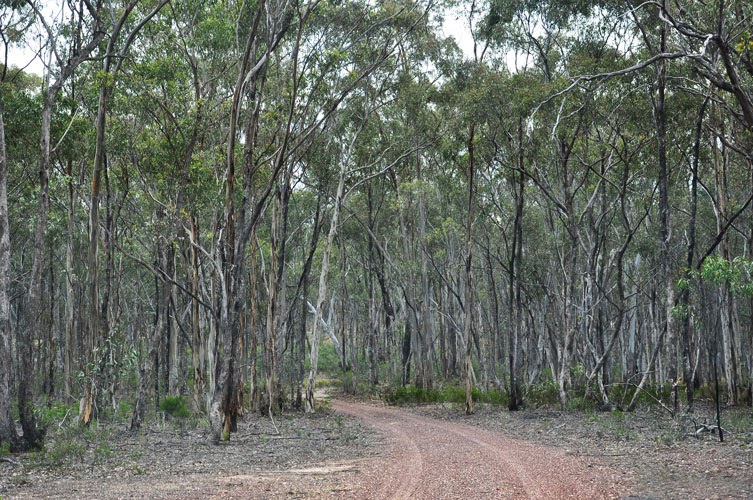
Graytown area as it is today - January 2013

By having the image of "
The Kormoran Monument" above, it is only right that I should include one for the HMAS Sydney as seen at Geraldton in West Australia, Australia.


Wikipedia has some information on the Battle between HMAS Sydney & German auxiliary cruiser Kormoran here.

With thanks to the extinct "The Ballan News",  The State Library of Victoria and Yvonne Cochrane for the information above.

Thanks to TROVE for articles from newspapers.

Thanks also to Monuments Australia, AWM (Australian War Memorial), Museum Victoria and the Australian National Maritime Museum for images.

There is a set of books (three volumes) titled "The loss of HMAS Sydney 11". Information from the Attorney Generals Department on those can be found here. 

I completed a blog post recently on a small town named COSTERFIELD, which is next to Graytown. If you would like to read that, it is here.

This blog post on Graytown really did start out to be about the Graytown Cemetery, with a small amount about the POW Camp and the prisoners.  But as I started doing the research on Graytown I found so many images and articles about the camp that were spread far and wide on all sorts of websites that I decided to do the blog on Graytown and the POW Camp and by doing so, collate most of the articles and images all in one place! 

The images can all be found on my PICASA site.

My next blog post will definitely be about the cemetery.


.